Japanese Rubber Futures Fall; Purchase Prices at Vietnamese Firms Hold Steady
On November 12, some rubber futures contracts on Japan’s Osaka Exchange fell, while Shanghai rubber futures and Thai RSS3 export prices rose. Analysts said Thailand’s peak harvest season and weak tire demand weighed on prices. Rubber purchase prices at the Vietnamese firms cited remained stable.

At the close on November 12, rubber futures for April 2027 delivery on the Osaka Exchange fell 0.98% to 436.5 yen per kilogram; the December contract was unchanged at 426.1 yen per kilogram. Rubber futures for January 2027 delivery on the Shanghai Futures Exchange rose 1.54% to 19,490 yuan per tonne. Thailand’s RSS3 rubber export quotation rose 1.32% to 92.74 baht per kilogram.
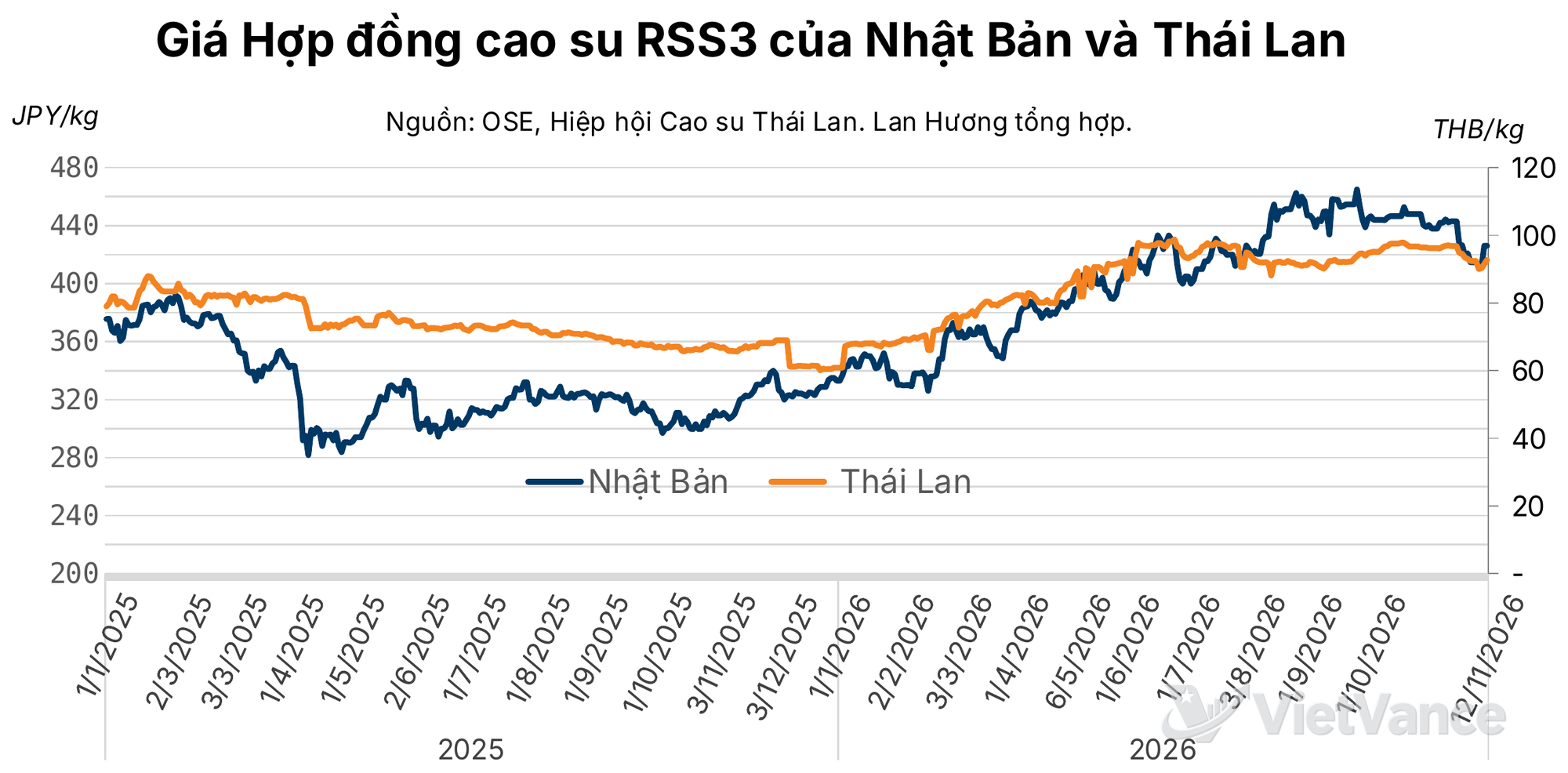
Trends in rubber futures prices in Thailand and Japan.(VietVance)
Analysts at Shenyin Wanguo Futures said Thailand is emerging from the rainy season and entering the peak rubber harvest, increasing supply. Tire production remains weaker than a year earlier, and both factors are putting pressure on prices. Analysts at Minmetals Futures said the sharp rise in Shanghai rubber futures on November 11 may have been linked to a World Meteorological Organization report on El Niño, but there is currently no evidence of widespread production cuts. If output during the peak season is normal, weather-related price gains could quickly fade.
In the spot market, Thai Rubber Association data showed that Thailand’s STR 20 rubber export quotation rose from 84.85 baht per kilogram in the previous session to 86.02 baht. Reuters’ Asian rubber price table showed that the price of Malaysian standard rubber SMR 20 remained at $2.51 per kilogram.
On November 6, India’s Directorate General of Trade Remedies recommended five-year anti-dumping duties of $288–565 per 100,000 medical rubber gloves imported from Malaysia and Thailand. The agency said glove imports from the two countries rose 38% year on year to 4.21 billion units during the investigation period from April 2024 to March 2025, accounting for about 81% of consumption in India. The proposed rates still require a decision and formal issuance by the Indian government.
In Vietnam, Bình Long’s rubber purchase price at its factory was 540 Vietnamese dong per TSC degree per kilogram, while its production teams paid 530 dong. The price of mixed rubber remained at 18,000 dong per kilogram. MangYang’s purchase prices for latex and mixed rubber also remained stable.
Source: VietVance