Hydropower Plant in Lào Cai Built Inside a Mountain
The Sử Pán 1 hydropower plant in Lào Cai has an underground powerhouse and a 2.74 km water tunnel. A project study reports rock bursts during tunnel construction, while 83% of the tunnels required no additional reinforcement. Its two generating units began operating in December 2018 and January 2019.

The Sử Pán 1 hydropower plant in the Sa Pa area of Vietnam’s Lào Cai province has an installed capacity of 30 MW across two generating units. Its powerhouse is built inside a mountain, alongside a 2,740 m water tunnel, a 415 m tailrace tunnel and a concrete arch dam up to 52.5 m high. More than 1,000 m of rock covers some of the underground works.
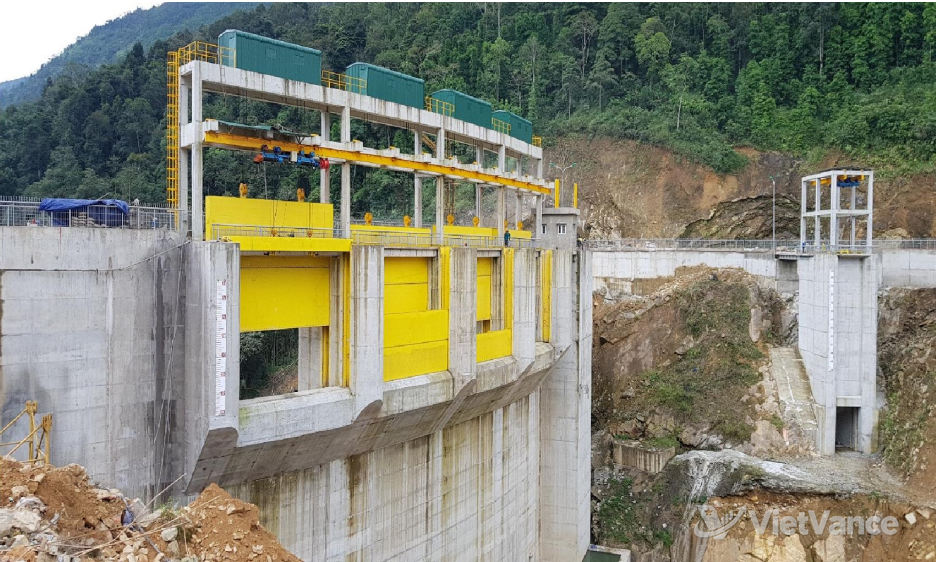
Sử Pán 1 uses an underground powerhouse, with more than 1,000 m of rock covering some of the underground works.(VietVance)
A study by researchers from SINTEF and PECC1 shows that, after comparing options including a surface powerhouse, the design team chose an underground powerhouse and a water tunnel with an 8.5% gradient, without a vertical shaft or surge tower. The study says this design reduced surface excavation and environmental impacts. At 2016 prices, estimated investment was about VND 35 billion per MW of installed capacity, 12% below the average for hydropower projects in Vietnam at the time.
The project owner is CTCP Công nghiệp Việt Long. Company materials published by CTCP Sông Đà 6 in 2019 show that its contract to build the arch dam was worth VND 74 billion, with construction taking place from 2016 to 2017. The owner also contracted ANDRITZ HYDRO, part of Austria’s ANDRITZ Group, to supply two 15 MW hydroelectric generating units and supporting systems.
During construction of the water tunnel, stress concentrated in the tunnel wall facing the mountainside. Rock bursts occurred in some sections, accompanied by the sound of cracking rock and fragments breaking loose. SINTEF conducted three-dimensional stress measurements on site from December 5 to 10, 2016. The results were used to design the underground powerhouse cavern and determine how much of the pressurized tunnel needed steel lining.
The project did not use concrete lining throughout its tunnels. Based on rock mass quality classifications, the study reports that 83% of the tunnels required no additional reinforcement, 13% were reinforced with rock bolts and shotcrete, and 4% used concrete lining. The underground powerhouse cavern also had no concrete lining. The first generating unit began operating in December 2018, followed by the second in January 2019.
Source: VietVance