Vietnam’s rubber purchase prices hold steady as Indian tire makers propose duty-free imports
On November 9, rubber purchase prices at Vietnamese companies remained stable, while Japanese and Chinese rubber futures and Thai export offers fell at the start of the week. Indian tire makers proposed temporary, limited duty-free imports as domestic natural rubber prices rose.

On November 9, rubber purchase prices at Vietnamese companies remained stable. Bình Long’s factory purchase price was 540 Vietnamese dong per TSC degree per kilogram, while its production teams paid 530 dong; mixed latex (DRC 60%) was priced at 18,000 dong per kilogram. MangYang’s purchase price for fresh latex was about 458 to 463 dong per TSC degree, while coagulated mixed latex was 404 to 459 dong per DRC degree.
At the opening of trading the same day, December rubber futures on Japan’s Osaka Exchange fell 0.7% to 411.9 yen per kilogram; Thailand’s RSS3 rubber export offer fell 0.35% to 92.08 baht per kilogram; and January 2027 rubber futures on the Shanghai Futures Exchange fell 0.59% to 18,510 yuan per metric ton.
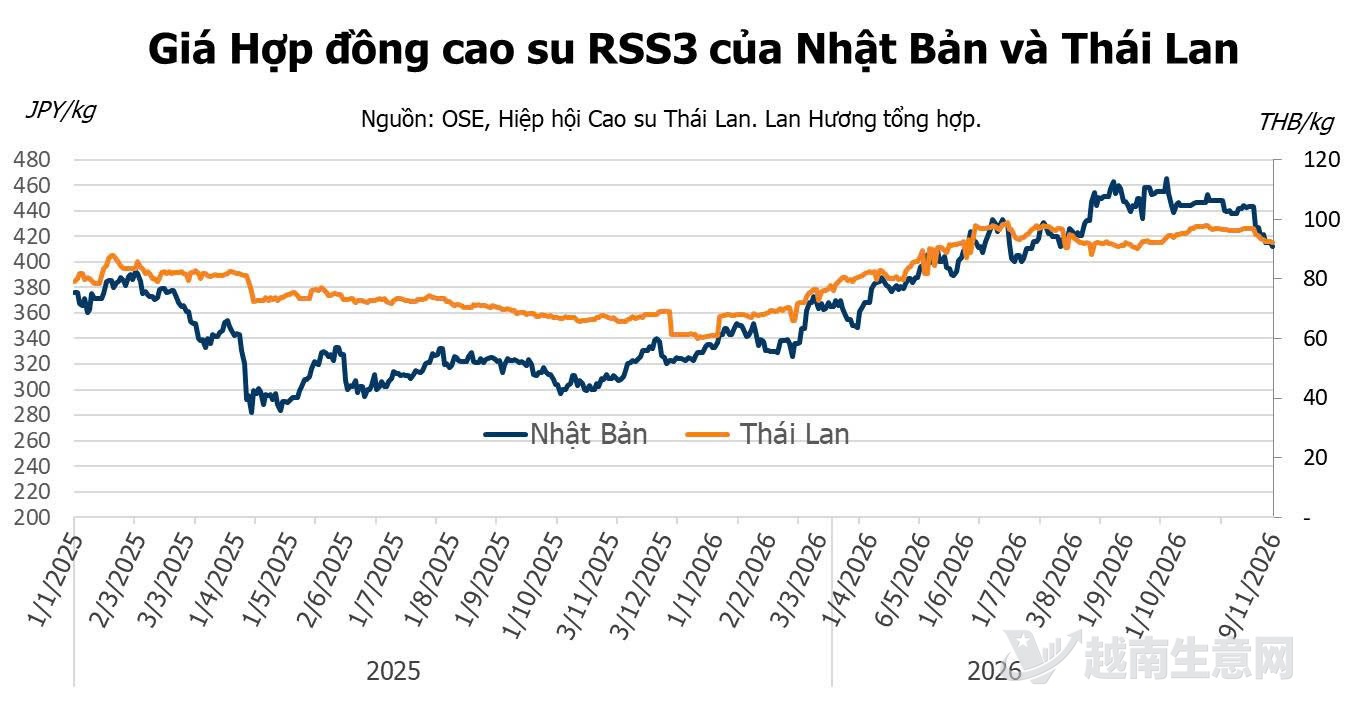
Rubber futures price trends in Thailand and Japan.(VietVance)
In India, the Automotive Tyre Manufacturers’ Association proposed that the government temporarily allow duty-free natural rubber imports under a tariff-rate quota, with imports limited to the gap between domestic demand and available supply. The Indian Rubber Board’s reference price for RSS4 rubber on November 6 was 298 rupees per kilogram, up nearly 62% from the November 2025 average of 186 rupees per kilogram.
India produced 905,000 metric tons of natural rubber in fiscal 2025–2026 and consumed 1.43 million metric tons. The source listed a supply shortfall of 522,000 metric tons. Rising raw material prices also affected tire makers: JK Tyre & Industries’ consolidated net profit for its second fiscal quarter ended September 30 fell 71% year on year to 651 million rupees, while total revenue rose 20.5% to 48.5 billion rupees. The company said its raw material costs had risen 30% over the past six months and it had yet to pass the full increase on to customers.
Source: VietVance