Southeast Asia’s digital economy projected to reach $1.139 trillion by 2035
Google, Temasek and Bain & Company project that Southeast Asia’s digital economy will grow from $368 billion in 2026 to $1.139 trillion by 2035. Small businesses in Vietnam are expanding through online sales, but limited digital skills and differing cross-border rules remain obstacles.

The e-Conomy SEA report by Google, Temasek and Bain & Company projects that Southeast Asia’s digital economy will grow 17% in 2026 to $368 billion, then reach $1.139 trillion by 2035. Over the same period, gross merchandise value in e-commerce is expected to rise from $226 billion to $820 billion, more than 3.6 times its original size.
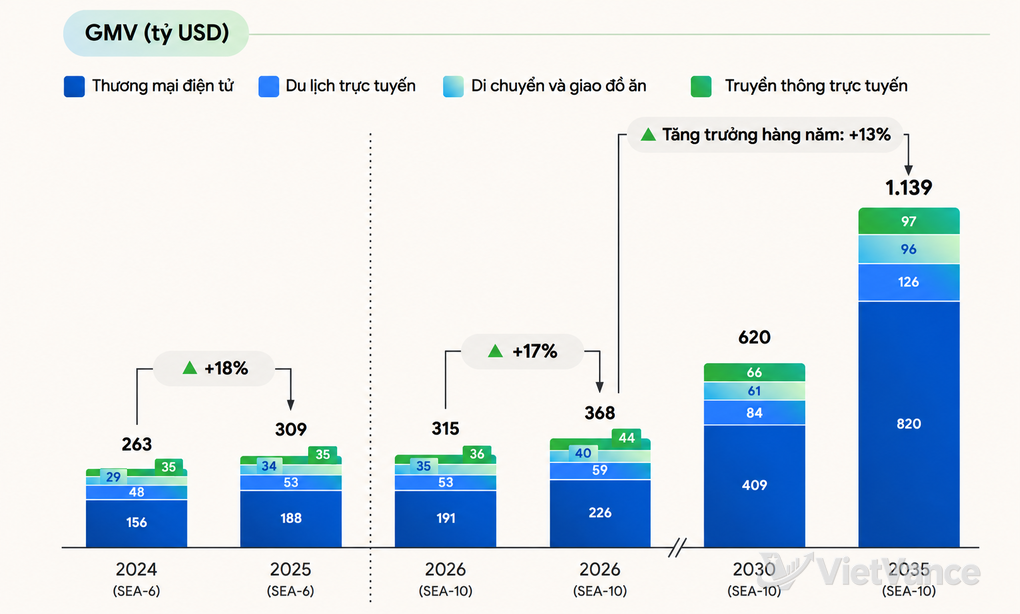
Size of Southeast Asia’s digital economy. Source: e-Conomy SEA 2026.(VietVance)
Văn Thị Loan, founder of Vietnamese coffee company Real Bean Coffee, started her business in 2019, initially focusing on wholesale coffee sales to businesses. Over the past two years, she has invested more in building the brand online, promoting its products through livestreams, videos and user engagement. She said greater online visibility has also boosted sales through distributors and offline channels; the company’s coffee sales across all channels have grown by an average of 30% a year.
Piti Srisangnam, executive director of the ASEAN Foundation, said data analysis, livestream sales and inventory management remain difficult for many small businesses. He said about 2,400 micro, small and medium-sized enterprises in Southeast Asia have joined an e-commerce training program launched in 2025. According to TikTok Shop, the participating businesses’ gross merchandise value increased 700% in 2026.
Cross-border business also faces differences among countries in e-commerce rules, platform policies, payments and customs procedures. ASEAN’s 11 member states signed the Digital Economy Framework Agreement in the Philippines on November 14, 2026. It covers digital trade, cross-border data flows, electronic payments, cybersecurity and artificial intelligence. The agreement is expected to take effect 180 days after signing, but whether businesses benefit still depends on subsequent regulatory updates and system integration in each country.
Source: VietVance