Vietnamese Banks’ Nonperforming Loan Ratio Rises to 2.3%
VIS Rating reports that the Vietnamese banking sector’s nonperforming loan ratio rose from 2.2% at the end of June 2026 to 2.3% in the first nine months of the year. Rising borrowing and operating costs weakened repayment capacity among individuals and small and medium-sized enterprises, putting greater pressure on smaller banks’ asset quality and profitability.

VIS Rating’s report on Vietnam’s banking sector for the first nine months of 2026 shows that the sector-wide nonperforming loan ratio rose from 2.2% at the end of June to 2.3%. The report says high lending rates and borrowing and operating costs weakened the repayment capacity of individual and small and medium-sized enterprise (SME) borrowers, increasing new nonperforming loans and banks’ asset risk. Tighter funding conditions and cash flow pressure stemming from geopolitical tensions also affected customers’ ability to repay.
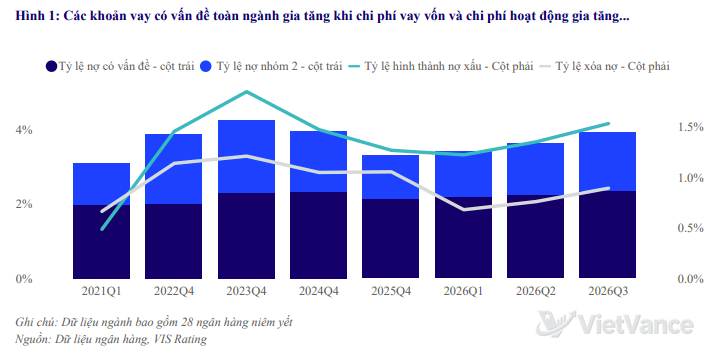
A chart on asset quality in Vietnam’s banking sector published by VIS Rating.(VietVance)
The decline in asset quality was more pronounced at small and medium-sized banks. VIS Rating attributes this to their greater exposure to vulnerable individual and SME borrowers. Its data show that the nonperforming loan ratios of large banks including Techcombank, ACB, Sacombank, HDBank, BIDV and Vietcombank rose by an average of 0.14 percentage points from the previous quarter, mainly involving housing and consumer loans, as well as SME loans in real estate, construction and manufacturing.
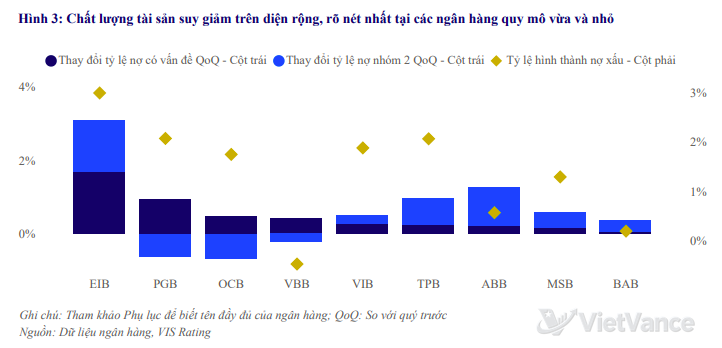
A chart on nonperforming loans at Vietnamese banks published by VIS Rating.(VietVance)
Profitability varied across banks. The sector-wide average return on assets remained at 1.5% in the first nine months, as higher lending yields and net interest margins at some large banks offset rising credit costs. Techcombank and ACB benefited from high-yield long-term loans to the real estate and construction sectors; profit growth at Vietcombank, VietinBank, Sacombank and HDBank slowed because of higher credit costs. Rising deposit costs also narrowed net interest margins at Sacombank and HDBank, while small and medium-sized banks faced more intense competition for deposits.
On capital buffers, the sector-wide ratio of tangible equity to total assets remained at 8.3% in the first nine months. In the third quarter of 2026, the nonperforming loan coverage ratio fell by 4 percentage points to 75% as problem loans increased. VIS Rating says existing capital-raising plans amount to less than 8% of sector-wide tangible equity and will take time to implement, limiting banks’ ability to strengthen their capacity to absorb losses. High borrowing costs could also keep asset risk elevated.
Source: VietVance