EU Deforestation Regulation Prompts Vietnam’s Agricultural and Forestry Exporters to Improve Traceability
The EU Deforestation Regulation requires Vietnamese coffee, rubber and timber exporters to provide information on product origins and the legality of production. Vietnam has compiled geolocation data for some growing areas, but fragmented records and gaps in land documentation remain. Businesses also need to improve supply chain traceability.

The EU Deforestation Regulation (EUDR) imposes stricter traceability requirements on Vietnamese exports such as coffee, rubber and timber, including checks on production areas, geolocation, the legality of production and supply chain information. At a seminar in Hanoi on November 20, 2026, participants said businesses need to improve data and production management to meet market access requirements.

Experts attend a seminar on the EUDR in Hanoi.(VietVance)
Ministry of Industry and Trade official Ngô Chung Khanh said environmental and sustainability requirements are appearing in more markets. Businesses should establish reliable traceability systems, update them promptly and use them for production management and brand building. He warned that inaccurate traceability information could damage the reputation of products, industries and even the country.
Nguyễn Thị Hoài, a representative of the Ministry of Agriculture and Environment, said Vietnam’s EUDR data and traceability platform is largely complete, has undergone information security assessment and testing, and is being prepared for official operation. On October 20, 2026, forestry authorities released the first version of a 2020 forest boundary map and a WebGIS platform for businesses and local authorities to check production areas against forest land boundaries.
According to data compiled by local authorities, by the end of October 2026, about 400,000 hectares of coffee-growing areas had geolocation data, accounting for more than half of Vietnam’s coffee-growing area. More than 300,000 hectares of rubber plantations belonging to the Vietnam Rubber Group (Tập đoàn Công nghiệp Cao su Việt Nam) and other large businesses also had such data. However, some cultivated land lacks documents proving its legal status, data formats used by local authorities and businesses are not yet standardized, and smallholder farmers and small and medium-sized businesses lack the capacity to collect and manage data.
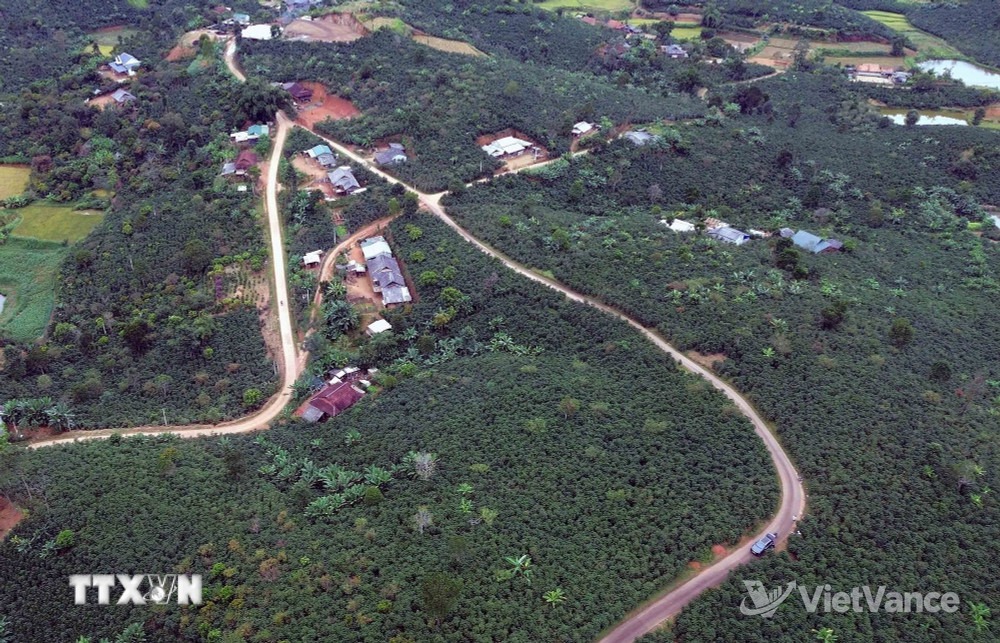
By the end of October 2026, about 400,000 hectares of coffee-growing areas in Vietnam had geolocation data.(VietVance)
Nguyễn Thị Hoài said the next steps are to verify, clean and integrate data on growing areas and support risk assessments for coffee and rubber production areas. Overlapping plots shown on a map do not, by themselves, establish a violation; land origin records and actual production conditions must also be considered. Ngô Sỹ Hoài, a timber industry representative, said the EUDR also requires reliable electronic evidence tracing timber from plantation plots through harvesting and onward to exporting businesses.
Source: VietVance