Vietnam’s live hog prices edge up in three localities as Dak Lak steps up African swine fever control
On November 19, live hog purchase prices rose by VND 1,000 per kg in Lao Cai, Gia Lai and Can Tho, while prices nationwide remained at VND 50,000–56,000 per kg. Dak Lak also announced African swine fever control measures; the province recorded 112 outbreaks from the start of 2026 through November 16.

On the morning of November 19, Vietnam’s live hog market was broadly stable. Purchase prices rose by VND 1,000 per kg only in Lao Cai, Gia Lai and Can Tho, reaching VND 54,000, VND 52,000 and VND 51,000 per kg, respectively. Nationwide, live hog purchase prices remained at VND 50,000–56,000 per kg.
In the north, purchase prices ranged from VND 53,000 to VND 56,000 per kg, with Hai Phong and Lai Chau at the regional high of VND 56,000 per kg. Prices were VND 50,000–55,000 per kg in the central and Central Highlands regions and VND 50,000–56,000 per kg in the south, where Dong Nai remained at VND 56,000 per kg.
Some experts forecast that live hog prices could resume rising on November 20, with room for prices in some localities to increase to VND 56,000–57,000 per kg. This is a forecast; those increases have not yet occurred.
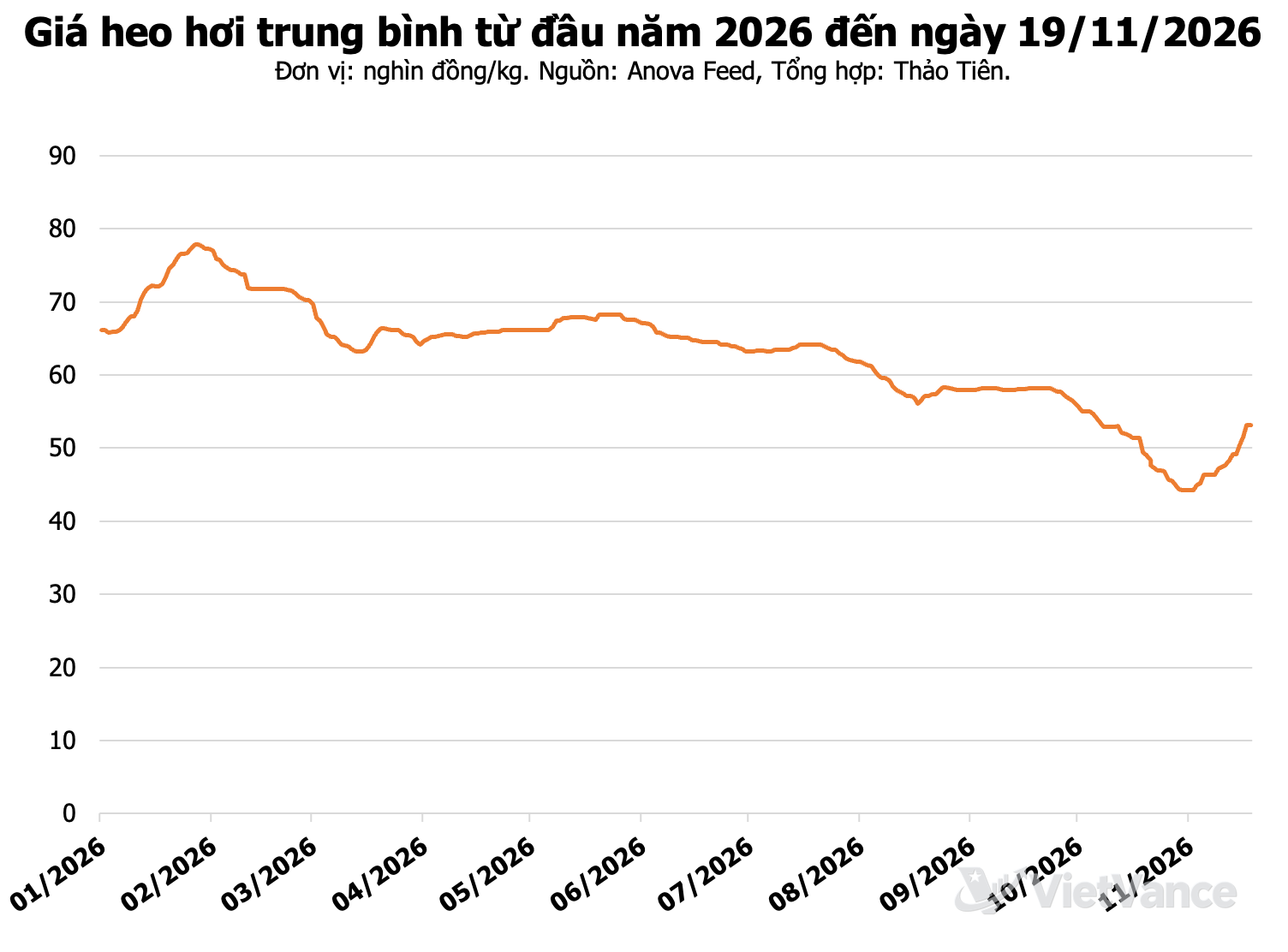
Live hog purchase prices across Vietnam were broadly stable, with modest increases in only three localities.(VietVance)
The African swine fever outbreak in Dak Lak is also drawing attention. The provincial Department of Agriculture and Environment reported 112 outbreaks among 354 farming households in 52 communes and wards from the start of 2026 through November 16. A total of 13,495 pigs became infected, died or had to be culled. Outbreaks in 29 communes and wards have yet to pass the 21-day mark, involving 3,853 infected and culled pigs.
On November 19, the Dak Lak Provincial People’s Committee issued a directive requiring local authorities to review pig numbers and farming and slaughter facilities, and to strengthen outbreak containment, disinfection and controls on people and vehicles entering and leaving the affected areas in those 29 communes and wards. Provincial agencies must also step up quarantine, transport and market inspections, and allocate funding for disease prevention and compensation for farmers’ losses to safeguard food supplies at the end of 2026 and during the 2027 Lunar New Year.
Source: VietVance