Vietnam pepper prices fall by up to VND 7,000/kg in a week
As of November 22, 2026, pepper purchase prices in Vietnam’s main producing areas had fallen by VND 4,000–7,000/kg from a week earlier. Black pepper export offers were unchanged. Nedspice forecasts global pepper production of 434,000–464,000 tonnes in 2026–2027, while El Niño remains a source of uncertainty for future harvests.

As of November 22, 2026, pepper purchase prices in Vietnam’s main producing areas ranged from VND 128,000 to VND 132,000/kg, down VND 4,000–7,000 from a week earlier. The price in Đắk Lắk was VND 132,000/kg, down VND 4,000; Đắk Nông was at VND 130,000/kg, down VND 5,000; Gia Lai and Bình Phước (Đồng Nai) were both at VND 128,000/kg, down VND 6,500; and Bà Rịa – Vũng Tàu (Ho Chi Minh City) recorded the largest decline, falling VND 7,000 to VND 128,500/kg.

Pepper purchase prices in Vietnam’s main producing areas fell over the week.(VietVance)
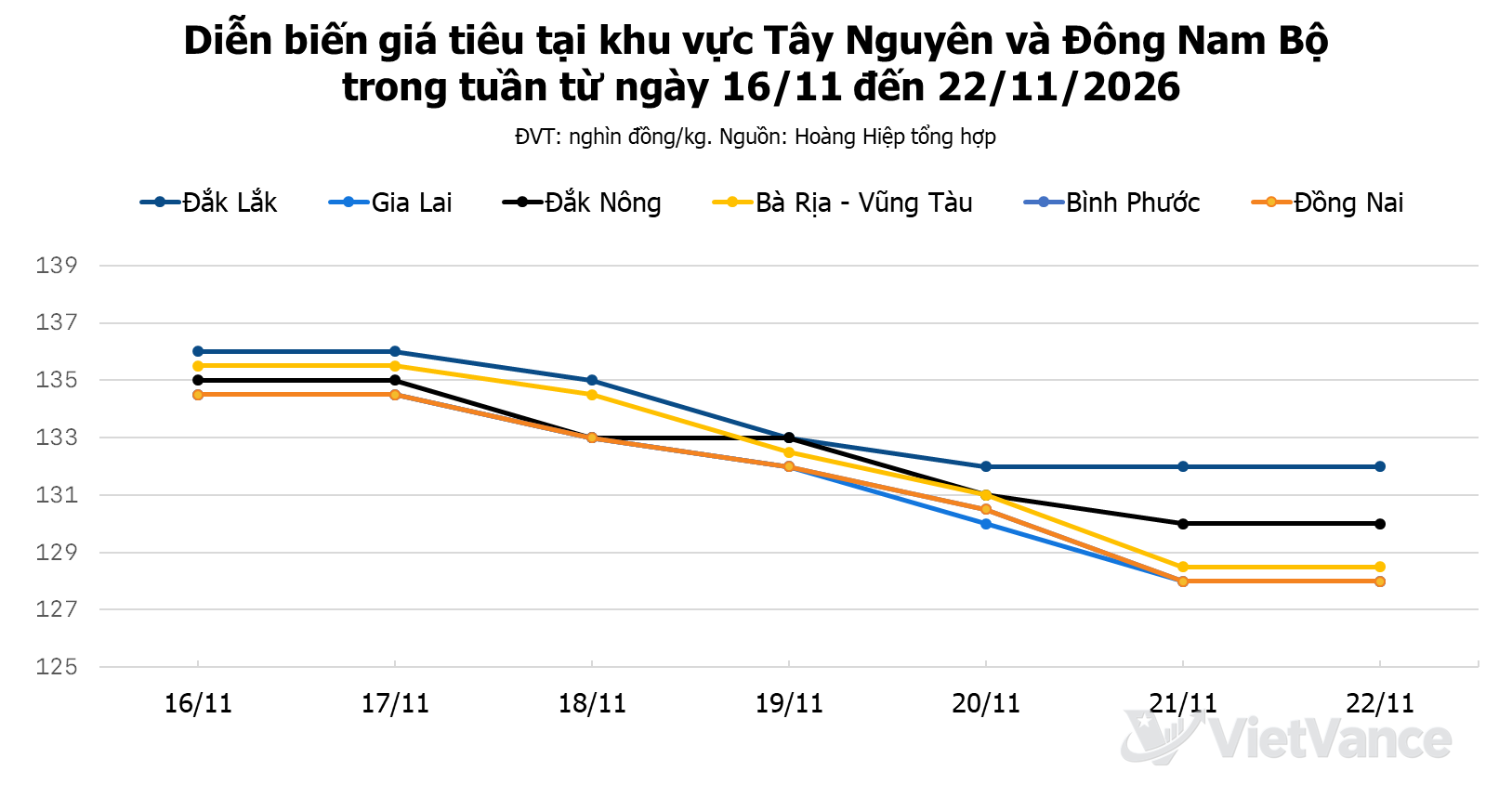
Pepper purchase prices in Vietnam’s main producing areas on November 22 and their weekly changes.(VietVance)
According to the International Pepper Community (IPC), Indonesian black pepper prices fell 0.32% from a week earlier to USD 6,748 per tonne, while Brazilian ASTA 570 black pepper fell 2.78% to USD 5,400 per tonne. Over the same period, Vietnam’s export offers for 500 g/l and 550 g/l black pepper remained at USD 5,700 and USD 5,900 per tonne, respectively, while its white pepper export offer held at USD 8,300 per tonne.
Nedspice forecasts global pepper production of 434,000–464,000 tonnes in the 2026–2027 crop year. Its report puts Vietnam’s production that year at about 155,000 tonnes, more than half below the 322,000-tonne peak in 2018–2019. The country’s average yield was roughly unchanged from the previous year at about 2.1 tonnes per hectare. Farmers are replanting pepper affected by disease and increasing intercropping with crops such as coffee.
Nedspice says El Niño poses a moderate risk to Vietnam’s next harvest, beginning in January 2027, although existing irrigation facilities should help limit its impact. If dry conditions persist, flowering and fruit development in the 2027–2028 crop year could be damaged, affecting production in 2028. The company also says demand continued to grow steadily in 2026, supported by increased US purchases and a recovery in Chinese imports.
Source: VietVance