Vietnam Pepper Purchase Prices Reach VND 138,000/kg on November 8
Vietnam’s domestic pepper purchase prices ranged from VND 135,500 to VND 138,000/kg on November 8, up VND 500–1,000 from the previous day and VND 1,000–1,500 from a week earlier. Vietnam’s black pepper export offers remained stable, while prices in major international markets changed little over the week.

On November 8, domestic pepper purchase prices in Vietnam ranged from VND 135,500 to VND 138,000 per kilogram, up VND 500–1,000 from the previous day. Across regions, prices rose VND 1,000–1,500 from a week earlier.

Domestic pepper purchase prices in Vietnam rose on November 8.(VietVance)
The purchase price in Đắk Lắk reached VND 138,000 per kilogram, the highest among the listed areas, up VND 1,000 from the previous day and VND 1,500 from a week earlier. Prices in Gia Lai, Bình Phước and Đồng Nai were all VND 135,500 per kilogram; the price in Bà Rịa – Vũng Tàu was VND 136,000. In Đắk Nông, the price rose VND 1,000 from a week earlier to VND 136,500 per kilogram.
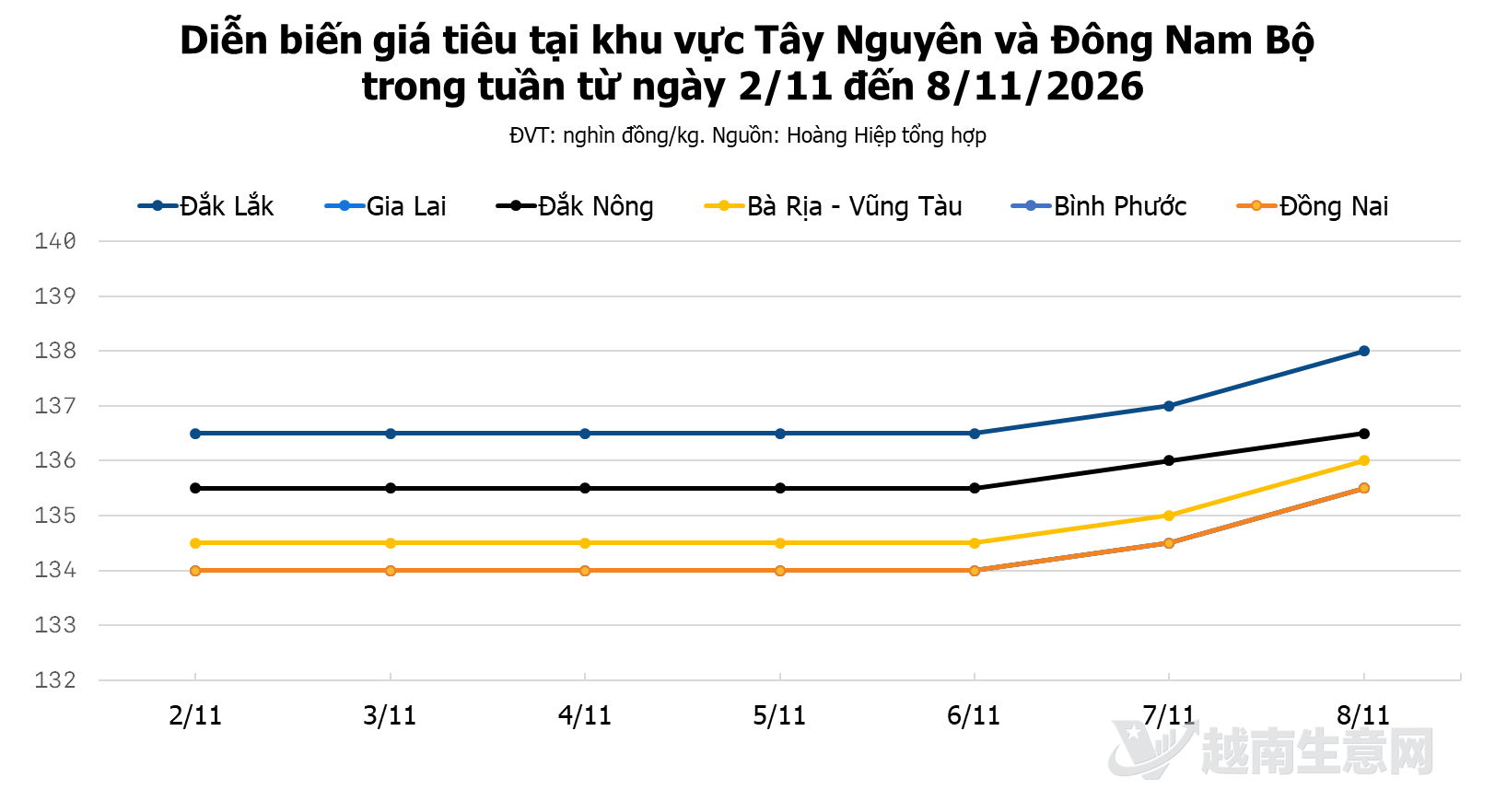
Pepper purchase prices and changes across Vietnam on November 8.(VietVance)
Data from the International Pepper Community show that prices in major international markets changed little over the past week. Indonesian black pepper fell slightly by USD 1 to USD 6,799 per ton; Brazilian black pepper was quoted at USD 5,700 per ton and Malaysian black pepper at USD 9,100. Vietnam’s export offers for two grades of black pepper held at USD 5,950 and USD 5,995 per ton, while its white pepper offer remained at USD 8,450 per ton.
Brazilian media reported that some black pepper producers in the state of Espírito Santo are adopting gas dryers, nets to reduce harvest losses and sterilization equipment to meet international buyers’ requirements. Juliano Câmara, general manager of Coreimex Representações Ltda., said controlling drying temperatures helps reduce the risk of contamination from smoke coming into contact with pepper and maintain product quality. He recommended slow drying at 60–70°C, depending on the processing method.
Source: VietVance