Vietnam’s Fresh Paddy Prices Rise on November 16 as Raw Rice Prices Fall
On November 16, fresh paddy and raw rice prices moved in opposite directions in Vietnam’s Mekong Delta. Several fresh paddy varieties rose in An Giang, while some raw rice prices fell. Prices for Vietnam’s main rice exports remained stable. The USDA forecasts global rice production in 2026–2027 at a three-year low.

On November 16, rice prices in Vietnam’s Mekong Delta diverged from the previous weekend. The price of IR 504 raw rice fell by 100 Vietnamese dong per kilogram to 9,400–9,500 dong, while OM 5451 raw rice fell by 300 dong per kilogram to 11,300–11,400 dong. Broken rice prices edged down, while rice bran prices remained stable.
On November 16, fresh paddy and raw rice prices moved in opposite directions in the Mekong Delta.(VietVance)
Data from An Giang’s Department of Agriculture and Environment showed that prices rose for several local fresh paddy varieties. Đài Thơm 8 rose by 300 Vietnamese dong per kilogram to 7,300–7,500 dong; OM 5451 rose by 200 dong to 6,600–6,700 dong; and DS1 rose by 400 dong to 7,600–7,700 dong.
According to the Vietnam Food Association, Vietnam’s Jasmine rice export offer remained at US$565–569 per tonne, while fragrant rice with 5% broken grains was quoted at US$535–540 and white rice with 5% broken grains at US$442–446. For the same grade of white rice, Thailand quoted US$488–492 per tonne and India US$388–392.
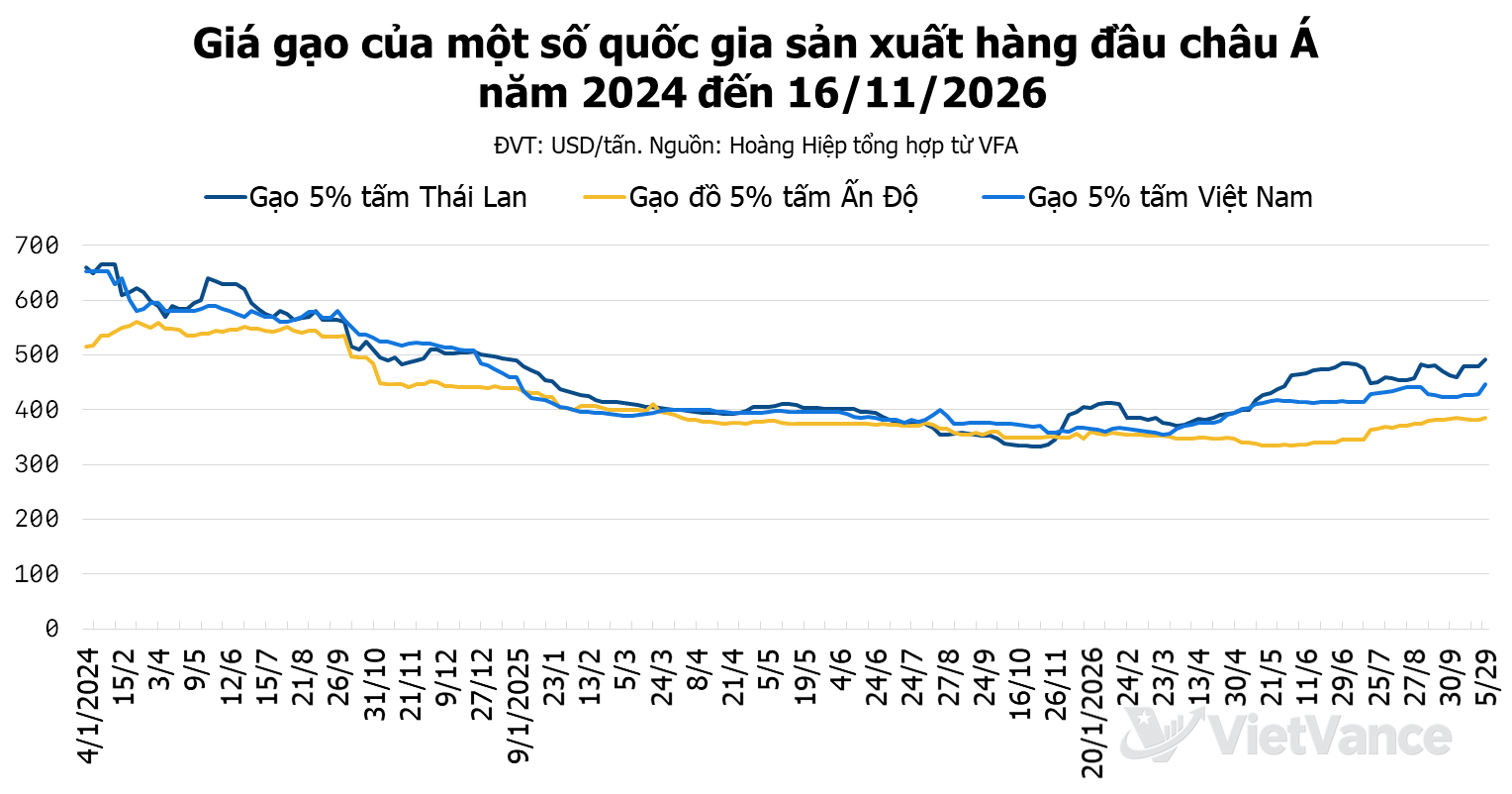
The USDA’s November report forecasts global rice supply and demand for 2026–2027.(VietVance)
In its November report, the USDA forecast global rice production in 2026–2027 at 533.2 million tonnes, up 100,000 tonnes from its October forecast but down 12.5 million tonnes from the previous year, the lowest level in three years. The agency forecast global rice consumption at a record 538.2 million tonnes. Global rice exports over the same period are projected to reach a record 60.3 million tonnes, despite a 1.1 million-tonne downward revision from last month’s forecast. A 1 million-tonne cut to India’s export forecast was the main reason for the lower global export forecast.
Source: VietVance