Vietnam’s finance minister addresses delayed tax refunds and e-commerce taxation
At a November 12 National Assembly questioning session, Finance Minister Ngô Văn Tuấn said tax officials who fail to process complete, compliant refund applications should be held accountable, including through financial compensation to taxpayers. He also outlined measures to manage cross-border e-commerce taxes but did not say whether delayed refunds would accrue interest at 0.03% per day.

During a National Assembly questioning session on November 12, 2026, Ho Chi Minh City delegate Trần Anh Tuấn said businesses that pay taxes late currently face a charge of 0.03% per day. He said the 2019 Law on Tax Administration required the state to pay businesses interest at the same rate for delayed tax refunds, but the 2025 Law on Tax Administration no longer contains that provision. He asked whether the state should continue paying interest at the same rate when refunds are delayed.
Finance Minister Ngô Văn Tuấn replied that if taxpayers submit complete applications that meet the requirements but tax officials fail to process them, those officials should be held accountable, including through financial compensation to taxpayers. He stressed that refund applications must comply with the law. The Finance Ministry is working to reduce processing time for applications in the green channel to seven days. Although all applications subject to inspection before refund are submitted online, checking invoices still takes time. His answer did not explicitly commit to paying interest at 0.03% per day.
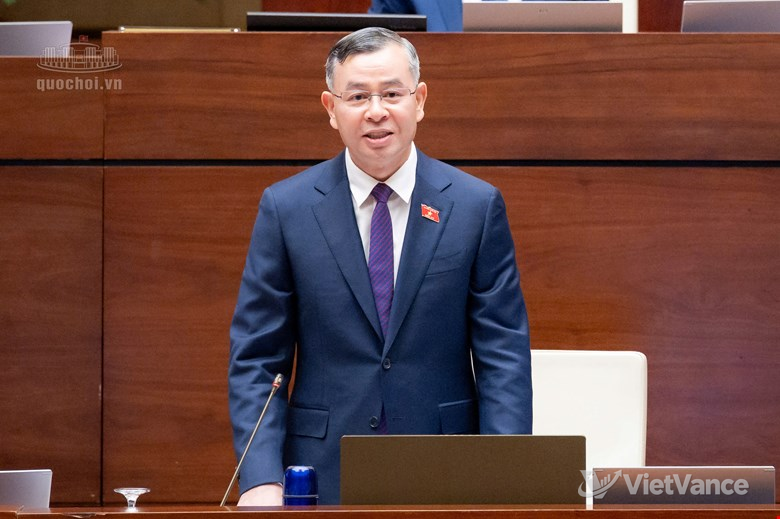
Finance Minister Ngô Văn Tuấn answers questions at the National Assembly.(VietVance)
Đắk Lắk delegate Đỗ Chí Nghĩa also questioned the minister about lost tax revenue from business conducted on digital platforms, saying cross-border operations pose challenges for determining revenue, monitoring transactions and enforcing tax obligations. Ngô Văn Tuấn said the Finance Ministry established a national online portal in 2022 for foreign suppliers to declare and pay taxes. He also cited the E-Commerce Law, which took effect on July 1, 2026, and requires global online platforms to have representatives in Vietnam.
Ngô Văn Tuấn said the keys to managing e-commerce taxes are verifying identities, collecting data and linking information on buyers, sellers, e-commerce platforms, logistics, shipping and payments. Tax authorities also need to share data with agencies overseeing payments. He said management measures already cover platforms doing business in Vietnam, including those without a presence in the country. Tax receipts from foreign suppliers on e-commerce platforms have grown rapidly in recent years, he said, without providing figures.
Source: VietVance