Vietnam’s Goods Trade Tops $1 Trillion for First Time in First 10 Months
Vietnam’s goods trade exceeded $1 trillion in the first 10 months of 2026, up 32.3% year on year. Foreign investment and electronics manufacturing support further growth, but reliance on imported components, cost pressures and limited domestic value added remain challenges.

In the first 10 months of 2026, Vietnam’s total goods imports and exports exceeded $1.01 trillion, up 32.3% year on year and surpassing $1 trillion for the first time. Vietnam’s statistics agency said the milestone reflects the country’s deepening ties to global production and consumption networks. Total trade rose from $100 billion in 2007 to $500 billion in 2019, then doubled over the following seven years.
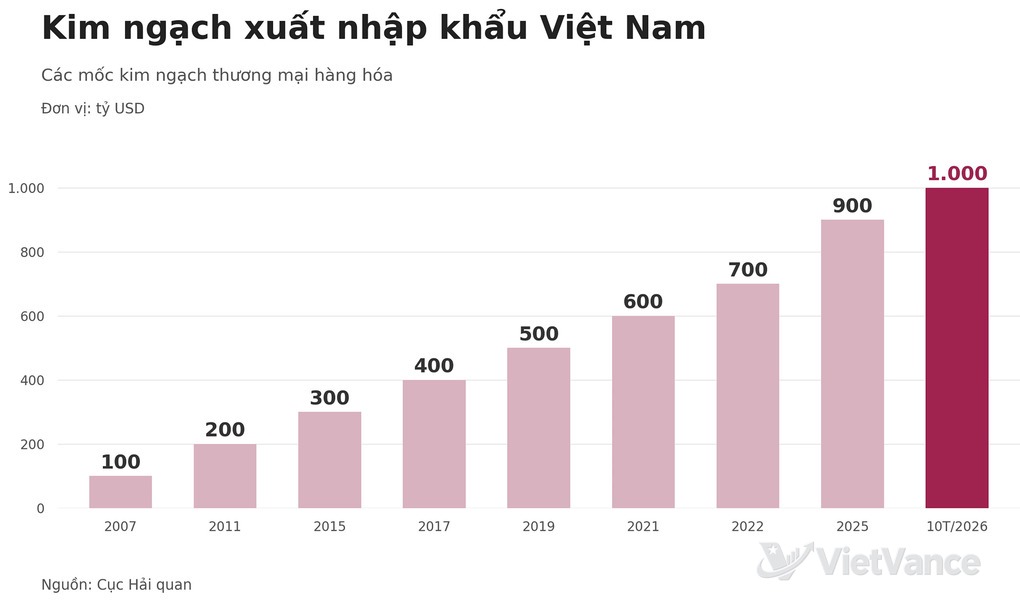
Changes in Vietnam’s total goods imports and exports since it joined the World Trade Organization.(VietVance)
By October 2026, Vietnam had joined 19 free trade agreements. Registered foreign direct investment reached nearly $55 billion in the first 10 months, the highest level for the period in 17 years, with 51.6% going to processing and manufacturing. Over the same period, electronics, computers, machinery and equipment, and mobile phone components and related products accounted for more than half of export value.
Expectations for trade expansion remain relatively positive. In a recent survey of 22 electronics manufacturers operating in Vietnam by recruitment firm Navigos Search, 82% planned to expand hiring over the next 12 months. An HSBC survey of 10,000 business executives across 26 markets found that companies in Vietnam and the Philippines were the most optimistic about the outlook for international trade.
Cost and hiring pressures persist. In HSBC’s survey, 52% of Vietnamese respondents cited tariff costs and 49% cited energy costs; 97% said obstacles still limited their wider use of free trade agreements. More than half of the companies surveyed by Navigos Search reported high or very high pressure in competing for talent, while 73% expected direct production roles to be the hardest to fill over the next three to five years.
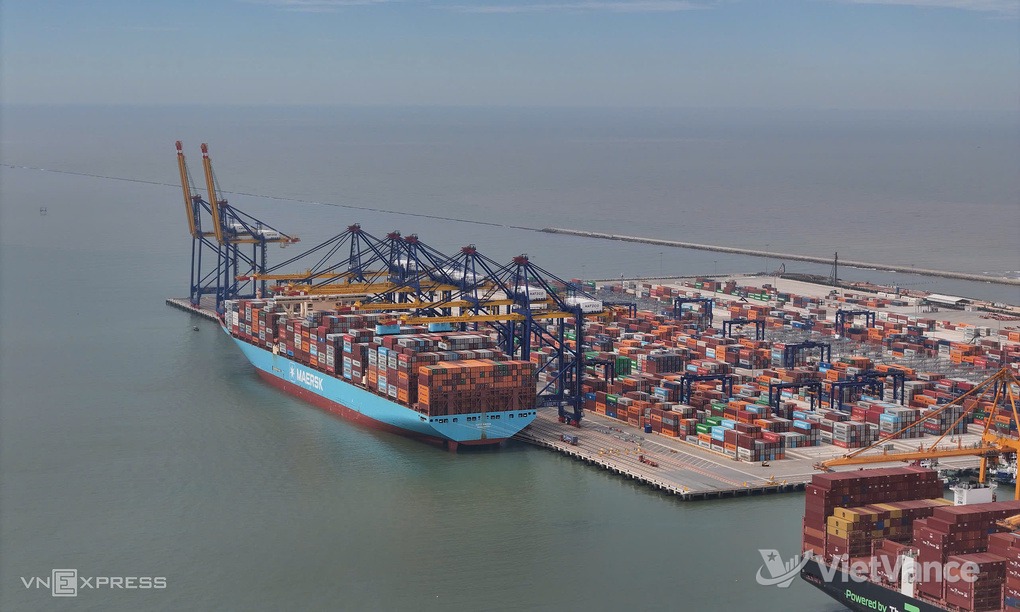
A deepwater port complex in Hai Phong, Vietnam, on June 23, 2026.(VietVance)
Total trade does not equal the value added within Vietnam. The country’s statistics agency said production and exports still depend substantially on imported raw materials and components. At an event in October 2026, a World Bank official said foreign-invested enterprises accounted for 73% of Vietnam’s export value, while Vietnamese businesses and workers retained too little of that value. The statistics agency said the next stage requires stronger domestic production capacity, a higher share of locally sourced inputs and more value added by Vietnamese businesses.
Source: VietVance