ASEAN Signs Digital Economy Framework Agreement
ASEAN member states signed the Digital Economy Framework Agreement on November 14, 2026, and plan to advance priority projects, including digital payments and digital business identities, to benefit businesses and consumers from early 2027. The agreement is scheduled to take effect 180 days after signing.

ASEAN member states signed the Digital Economy Framework Agreement (DEFA) on November 14, 2026, and began advancing the first projects under the agreement, aiming to benefit businesses and consumers from early 2027. The agreement is scheduled to take effect 180 days after signing, replacing the 2019 ASEAN Agreement on Electronic Commerce.
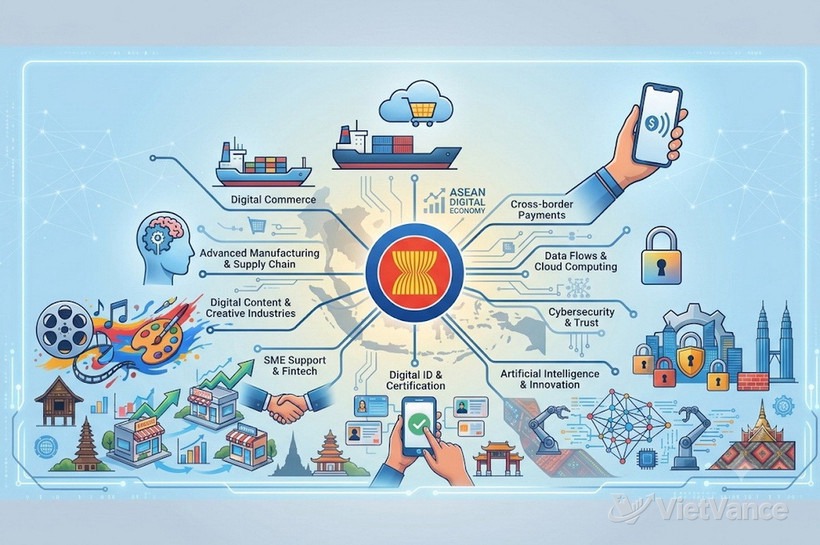
An AI-generated illustration related to the ASEAN Digital Economy Framework Agreement.(VietVance)
Singapore Deputy Prime Minister Gan Kim Yong said after the signing ceremony that DEFA is ASEAN’s first standalone, legally binding digital economy agreement. It establishes common rules for digital trade, cross-border data flows, electronic payments, cybersecurity and artificial intelligence. Priority projects could include digital payment systems, digital identities for businesses and electronic trade documents, with the aim of making cross-border transactions more efficient and less costly.
Gan Kim Yong also discussed Singapore’s economic priorities when it assumes the ASEAN chairmanship from the Philippines in 2027: deepening integration within ASEAN and expanding cooperation with external partners. Alongside implementing DEFA, Singapore hopes to advance an ASEAN Green Economy Framework Agreement and strengthen ASEAN’s ties with the European Union, the Gulf Cooperation Council and members of the Comprehensive and Progressive Agreement for Trans-Pacific Partnership. Negotiations on an ASEAN–Canada free trade agreement have made progress, with the aim of signing it in 2027.
Singapore’s Ministry of Energy, Trade and Industry cited a report by Google, Temasek and Bain & Company projecting that ASEAN’s digital economy will reach US$368 billion in 2026 and exceed US$1 trillion by 2035.
Source: VietVance