Ho Chi Minh City’s Nearly VND 1 Trillion Tidal Flood Control Project Set to Begin Operations in Late November
Ho Chi Minh City plans to bring six major tidal control gates into operation on November 30, 2026, as part of a project costing nearly VND 1 trillion. Covering about 570 square kilometers and serving around 6.5 million people, its ability to reduce flooding will also depend on drainage capacity, the completeness of embankments and coordination among facilities.

Ho Chi Minh City plans to bring six major tidal control gates into operation on November 30, 2026. Launched in 2016, the project has an investment of nearly VND 10 trillion, covers about 570 square kilometers and serves around 6.5 million people. The six gates are among the project’s nine main components, and their operation is expected to improve water level control in rivers and canals within the protected area.
The project closes its gates when external tides rise and opens them to drain water after the tide recedes, reducing the pressure that tidal backflow places on the city’s drainage system. But flooding caused by heavy rain also depends on factors such as the drainage network, the capacity of rivers and canals, and land subsidence. When heavy rain coincides with high tides, rainwater inside the protected area must still be discharged through the drainage network, water retention facilities and pumps while the gates are closed.
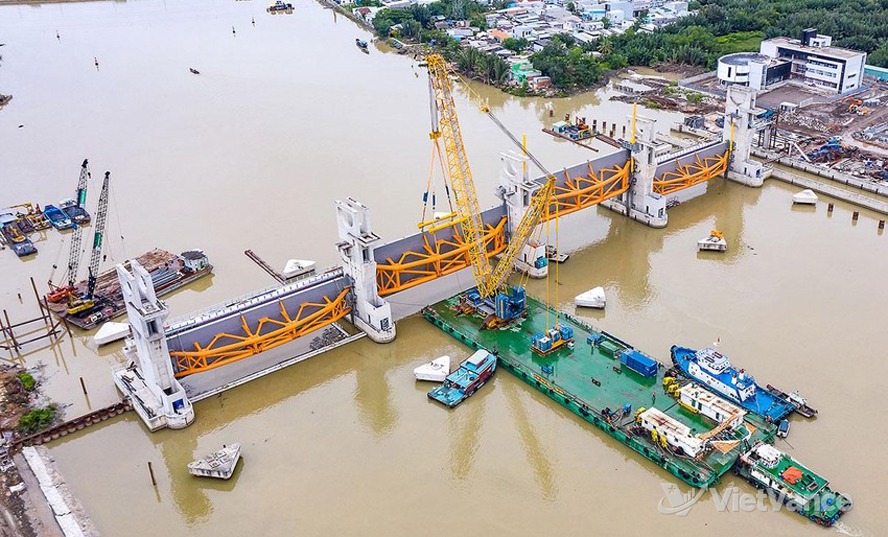
One of the project’s six major tidal control gates, which are among its nine main components.(VietVance)
According to the Ho Chi Minh City Department of Construction, the existing drainage system was designed for a three-year recurrence interval, corresponding to 85.36 millimeters of rain in three hours and a tidal level of +1.32 meters. Drainage facilities may still be overwhelmed when rainfall exceeds that design standard. The project investor, Trung Nam Construction Investment Joint Stock Company (Trungnam Group), has urged the city government to address 19 low embankment sections where the flood barrier remains incomplete, reducing the risk of tidal water entering elsewhere after the gates close.
Once the project enters operation, the units managing the gates, drainage network, pumps, rivers and canals will need to coordinate their operations according to water levels and rainfall. The investor has pledged to support operations, staff training and technology transfer in the initial phase. Ho Chi Minh City also plans to carry out 87 flood control projects from 2026 to 2030, with total investment expected to exceed VND 142 trillion. Of these, 54 projects are planned for 2026 to 2027, with investment of about VND 69.348 trillion.
Source: VietVance