Ninh Binh’s VND 1.76 Trillion Waste-to-Energy Plant Receives Its First Waste Deliveries
The Greenity Nam Định waste-to-energy plant in Ninh Binh received its first household waste on November 26, 2026, beginning trial operation of its waste incineration and power generation system. The VND 1.76 trillion project plans to gradually increase daily waste intake over its first three weeks.

On November 26, 2026, the Greenity Nam Định waste-to-energy plant in Mỹ Lộc Ward, Ninh Binh Province, received its first household waste deliveries, beginning trial operation of its waste treatment and power generation system. The project represents an investment of VND 1.76 trillion; receiving waste does not mean it has entered commercial operation.
Under a plan proposed by Greenity Nam Định Energy Joint Stock Company (Công ty Cổ phần Năng lượng Greenity Nam Định), the plant expects to receive about 300 tonnes of household waste per day in the first week, rising to 500 tonnes in the second week and 700 tonnes in the third, before gradually reaching its designed intake capacity. The phased increase will allow technical parameters to be adjusted and the system’s performance to be assessed ahead of commercial operation.
Waste arriving at the plant is first weighed on a weighbridge. Data on the weight received will be sent to the Ninh Binh Department of Agriculture and Environment for tracking and oversight. Vehicles then enter the reception area and unload the waste into a storage pit with a capacity of more than 10,000 tonnes. The facility has measures to prevent seepage, collect leachate and control odors.
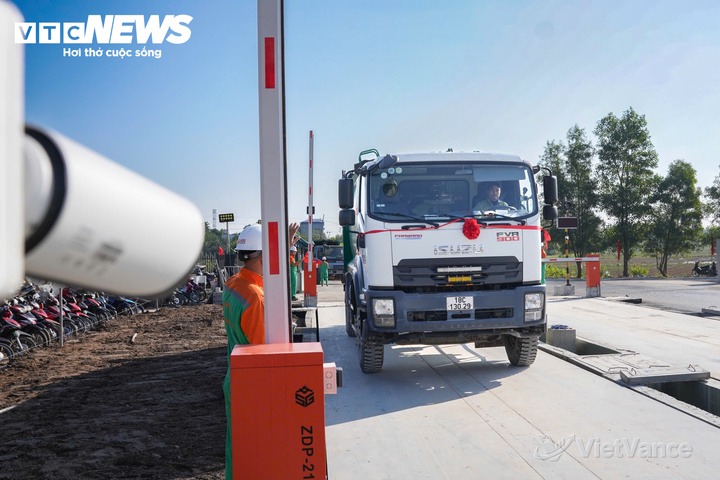
Waste arriving at the plant is first weighed on a weighbridge. The weight data is used for subsequent tracking and oversight.(VietVance)
The plant has a centralized control system to monitor operations from waste reception and treatment through to power generation. Each shift in the central control room has six staff: three boiler operators, two turbine operators and one shift supervisor. Once the project is operating steadily, it is expected to increase Ninh Binh Province’s household waste treatment capacity and use energy from waste incineration to generate electricity.
Source: VietVance