Trump Proposes Heavy Taxes on U.S. Companies Building Data Centers Overseas
President Donald Trump has proposed high taxes on U.S. companies that build data centers overseas to keep investment at home. Local residents are concerned about electricity demand, while the U.S. is advancing energy permitting legislation and restricting some advanced AI chip exports.

U.S. President Donald Trump recently said he plans to impose “huge taxes” on American companies that build data centers overseas. Speaking about the artificial intelligence industry at the White House, he said he would not allow companies to build data centers outside the United States, but gave no proposed tax rate or implementation date.
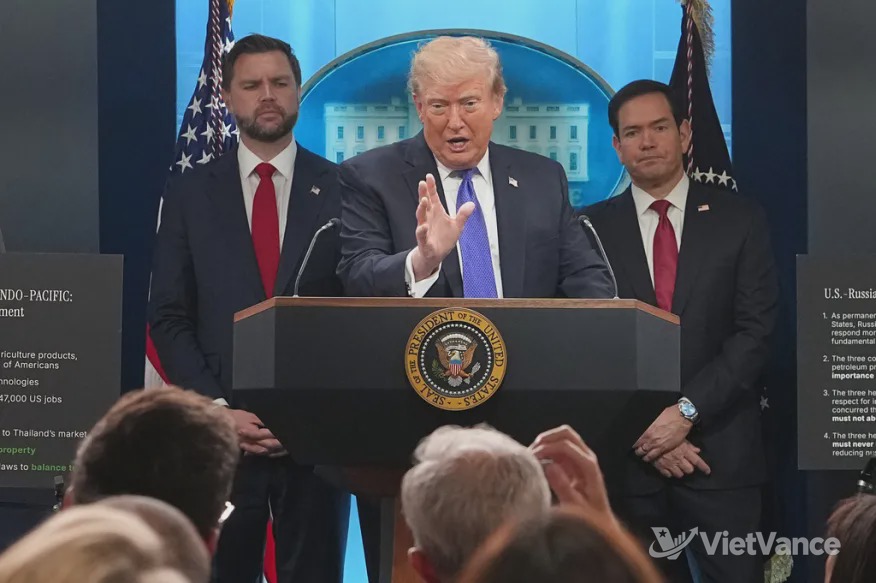
U.S. President Donald Trump speaks at a press conference.(VietVance)
Trump wants to keep data center investment in the United States, while local residents worry that the projects’ heavy electricity use will raise household power bills. An Associated Press survey of voters in the 2026 U.S. election found that about three-quarters of respondents opposed a new data center near their homes; another survey it conducted in the summer found that about six in ten Americans supported limiting the number of newly approved data centers. Trump believes companies could reach agreements with local communities by reducing residents’ utility bills, cutting taxes or making direct payments.
Economists at UBS estimate that major technology companies worldwide will invest about $1.8 trillion in artificial intelligence in 2027, with most of the money going to data centers. The investment has raised incomes for some U.S. construction workers, but many components and materials needed to build and operate the facilities still have to be imported.
On November 19, the U.S. Senate passed a bill aimed at speeding up reviews and permits for energy projects, including power plants and transmission lines. The bill requires data centers to pay the full cost of the electricity they use and the cost of upgrading transmission systems to meet their needs.
Earlier this week, the U.S. Department of Commerce took steps to restrict exports of advanced artificial intelligence chips to some Southeast Asian countries to prevent China from obtaining advanced semiconductor technology through third parties. Reuters said chip export controls have not completely closed the route of renting computing capacity from data centers in third countries, and the United States is examining such indirect channels.
Source: VietVance