US-Russia-China Summit Discusses Nuclear Security and Global Governance
The leaders of the United States, Russia and China held a trilateral summit in Shenzhen on November 19. Russian experts say it opened a channel for nuclear security dialogue and may reduce the risk of direct confrontation, but the joint statement yielded limited concrete results and the three countries remain divided over issues including UN reform.

US President Donald Trump, Russian President Vladimir Putin and Chinese President Xi Jinping held a trilateral summit in Shenzhen on November 19 during the APEC leaders’ meeting. Russian analysts said the meeting provided a new channel for the three countries to discuss security issues and could help reduce the risk of direct confrontation, but had yet to produce a substantive breakthrough.
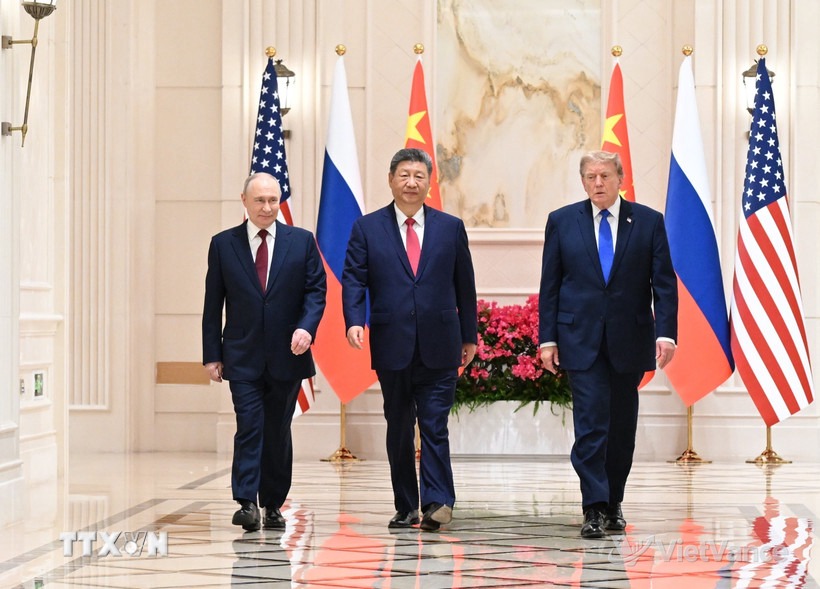
Xi Jinping, Vladimir Putin and Donald Trump held a trilateral summit in Shenzhen, China, on the afternoon of November 19, 2026.(VietVance)
Vasily Kashin of Russia’s Higher School of Economics (HSE) said China’s fuller participation in discussions on nuclear security and nonproliferation was an important change resulting from the meeting. He also noted that the United States had yet to achieve its goal of persuading China to negotiate reductions in its nuclear arsenal or disclose its size. He suggested that the three countries focus on establishing a mechanism to monitor how nuclear weapons are operated and deployed, to reduce the risk of strategic miscalculation.
In a joint statement, the three leaders reaffirmed that there can be no winner in a nuclear war. The statement did not repeat the commitment in a January 2022 joint document by five nuclear-weapon states to prevent any armed conflict among nuclear powers. Dmitry Suslov of HSE said the three leaders recognized the need to keep relations stable and prevent competition from escalating into direct military conflict.
The three countries agreed that the United Nations needs reform to better fulfill its peacekeeping mission, but differed over how to carry it out. The United States supports giving Japan and Germany seats on the UN Security Council, a proposal Russia and China did not endorse. Dmitry Novikov of HSE also analyzed the joint statement’s reference to the International Criminal Court, saying it reflected shared concerns among the three countries about existing international institutions.
The joint statement also addressed cooperation aimed at increasing oil extraction and refined petroleum product output in all three countries. Independent investment adviser Andrey Kochetkov was cautious about the plan’s feasibility, pointing out that oil production and the expansion of transport infrastructure cannot be achieved through declarations alone.
Source: VietVance