

Vietnam sets battery storage power price ceiling at VND 3,209.98 per kWh
Vietnam’s 2026 power generation price ceiling for battery energy storage systems takes effect on November 11 at VND 3,209.98 per kWh, excluding VAT. It is nearly 49% above the current average retail electricity price. Vietnam Electricity plans further battery storage installations and investment in 2026 and 2027.

Vietnam’s Ministry of Industry and Trade has decided that, from November 11, 2026, the 2026 power generation price ceiling for battery energy storage systems (BESS) will be VND 3,209.98 per kWh, excluding value-added tax. This ceiling is nearly 49% higher than the current average retail electricity price. The average retail price in effect since November 1 is VND 2,159.90 per kWh.
In calculating the price ceiling, the ministry assumed that a fully charged battery could supply electricity continuously at its rated capacity for two hours, with a charging and discharging efficiency of 85%. Over a 15-year economic life, the system would complete at least 8,000 charging and discharging cycles, with capacity declining by an average of 2% a year. The ceiling is nearly 47% higher than this year’s power generation price ceiling for onshore wind in northern Vietnam and about 51% higher than the ceiling for floating solar power with storage systems in the north; both of those prices exclude value-added tax.
Storage systems can store electricity when solar power generation is high during the day and supply it to the grid in the evening as demand rises. Some projects, including renewable energy projects, are already equipped with battery energy storage systems.
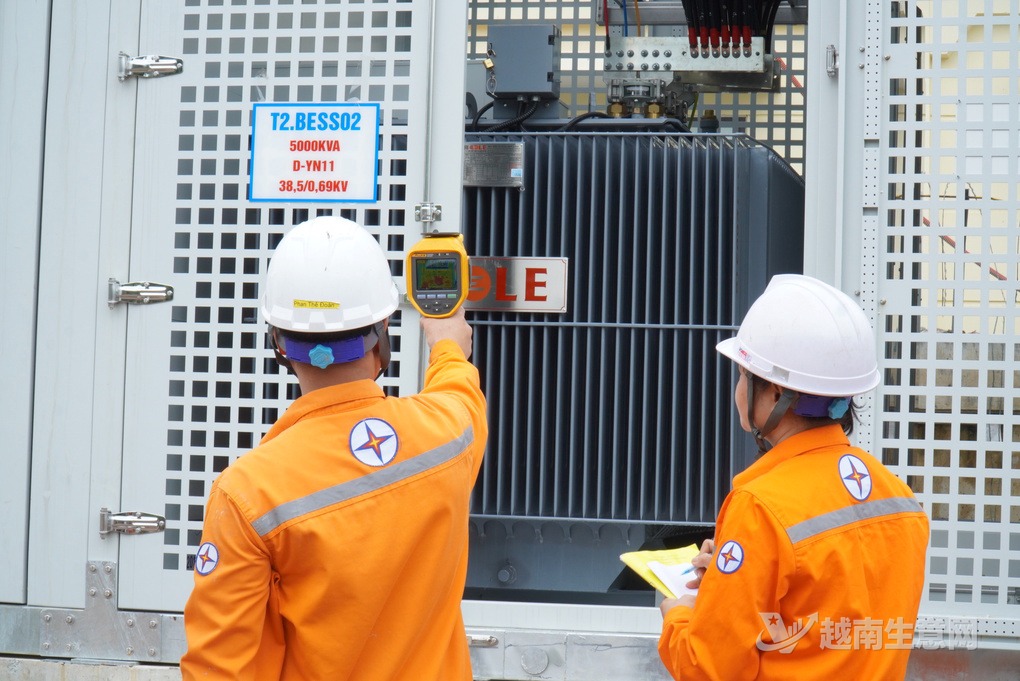
Electricity workers inspect a battery energy storage system in Bac Ninh.(VietVance)
2026 will be the first year Vietnam Electricity (EVN) installs battery energy storage systems. The capacity of its storage systems in northern Vietnam is expected to reach 805 MW. EVN plans to invest in about another 930 MW in 2027, with installations at the Thai Binh Thermal Power Plant, Mong Duong 1 Thermal Power Plant and some sites on Hanoi’s distribution grid.
Under Vietnam’s revised Power Development Plan VIII, the country expects to have 10,000–16,300 MW of battery energy storage capacity by 2030. The plan requires storage systems at utility-scale solar power plants to have capacity of at least 10% of the plant’s capacity and to provide two hours of storage.
Source: VietVance