Vietnam’s Online Greenhouse Gas Reporting System Set to Launch in 2027
Vietnam has piloted an online greenhouse gas reporting system that automatically calculates emissions across five sectors and lets authorities track company submissions and reviews. Piloted with more than 1,000 companies, it is scheduled to begin official operations in 2027 and later connect to the national carbon allowance and credit registry.

Vietnam has piloted and refined an online greenhouse gas reporting system, with official operations planned from 2027. The system includes a tool that automatically calculates emissions across five sectors: industry and trade, construction, transport, waste management and agriculture. Its calculations follow relevant sector guidelines and international standards.
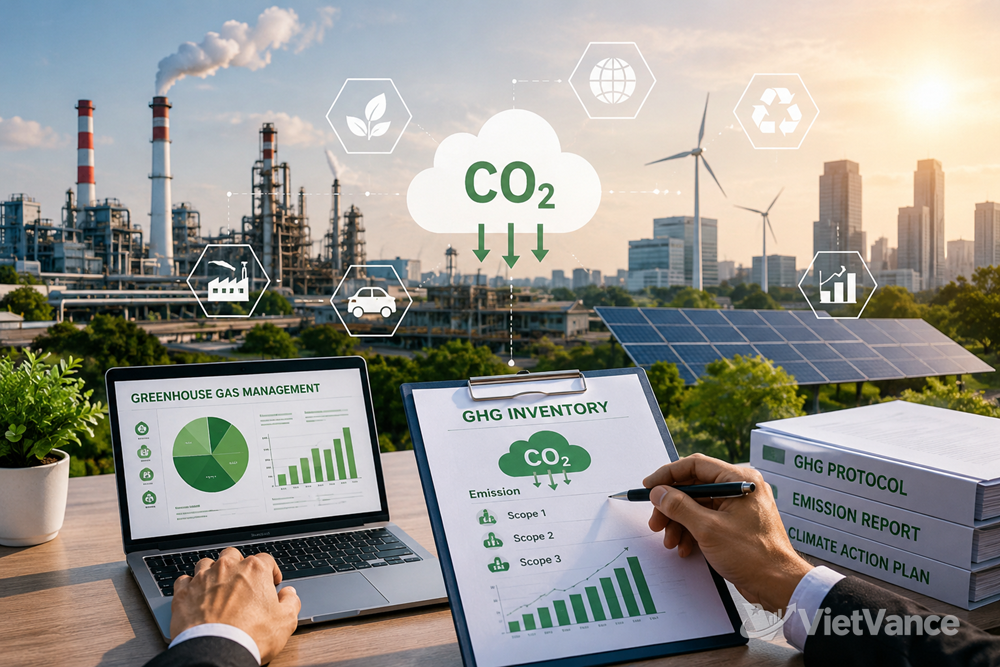
The online greenhouse gas reporting system can automatically calculate emissions across five sectors.(VietVance)
The system can connect data from different ministries and provides administrative accounts for the Ministry of Agriculture and Environment, the Ministry of Industry and Trade, and the Ministry of Construction. Central and local authorities can use it to see how many facilities are required to conduct emissions inventories and track the submission, verification, revision and approval of each company’s report. The system aims to standardize data collection and reporting and reduce errors from manual processing.
Nguyễn Tuấn Quang, director of the Department of Climate Change, said accurate, verified emissions data from facilities are essential to a transparent and effective carbon market. Vietnam’s Law on Environmental Protection and Decree No. 06/2022/NĐ-CP established greenhouse gas inventory obligations, including for major emitting facilities. The government subsequently issued Decree No. 119/2025/NĐ-CP and Decree No. 112/2026/NĐ-CP.
Authorities previously conducted capacity assessments and field surveys in 12 provinces and cities, piloted the system with more than 1,000 companies, and held more than 100 online and in-person training sessions. From 2026 to 2030, the system is planned to expand to sectoral and national levels, digitize the measurement, reporting and verification of emissions reduction activities, and issue electronic certificates for carbon credit projects. The platform is also planned to connect to the national carbon allowance and credit registry, providing data to help prevent double counting and support carbon trading.
Source: VietVance