Vietnam Proposes Studying a 1,000-Kilometer Ultra-High-Voltage Power Line
Vietnam’s Ministry of Industry and Trade proposes studying a roughly 1,050-kilometer direct-current transmission line from the south-central coast to the Red River Delta. Its planned capacity is 6,000–8,000 MW, with a preliminary investment estimate of about $3.47 billion.

In a proposed revision to Power Development Plan VIII now open for comment, Vietnam’s Ministry of Industry and Trade has proposed prioritizing a ±800 kV ultra-high-voltage direct-current transmission line from the south-central coast to the Red River Delta. The line would run about 1,050 kilometers and have a projected transmission capacity of 6,000–8,000 MW. If built, it would be Vietnam’s first transmission line of this kind.
The proposed line’s southern converter station would collect electricity from the north-central and south-central coastal regions through the 500 kV grid, convert it to direct current and send it north. There, it would be converted back to alternating current for the local grid. Unlike existing alternating-current lines, direct-current technology also allows the power transmitted through the line to be adjusted directly.
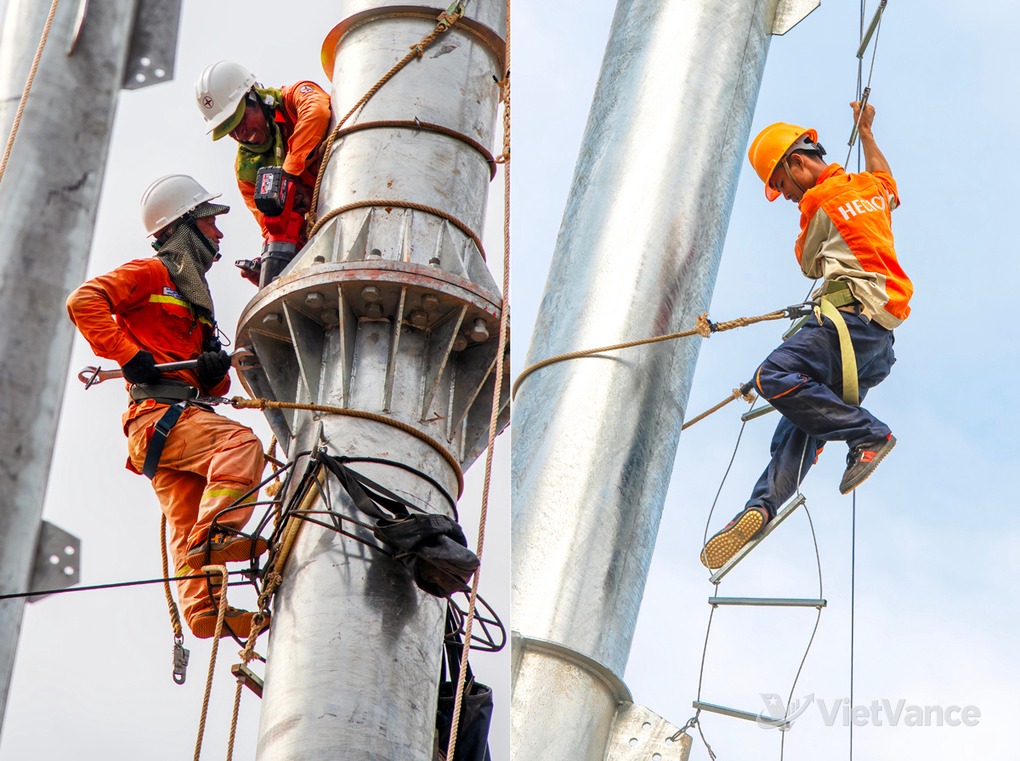
Workers install busbars weighing several tons at the construction site of the third 500 kV circuit. Photo: Vietnam Electricity.(VietVance)
Vietnam’s northern and southern power grids are currently connected by four 500 kV alternating-current circuits. The first two began operating in 1994 and 2005, respectively. The double-circuit 500 kV Quảng Trạch–Phố Nối line, known as circuit 3, was completed and energized in 2024. Under the proposed plan revision, the 500 kV grid would continue to carry the additional electricity sent north over the next few years, with two more transmission corridors planned.
The Institute of Energy, which is under the Ministry of Industry and Trade, estimates that electricity transmitted from central to northern Vietnam could rise from 32.8 billion kWh in 2027 to 47.4 billion kWh in 2030. By 2035, the Red River Delta could receive 90.5 billion kWh from central Vietnam, of which about 45 billion kWh would be carried by the proposed direct-current corridor. The institute’s preliminary comparison puts investment in the ±800 kV direct-current option at about $3.47 billion, with both its investment cost and discounted cost the lowest among the options compared. Because preparation and construction could take 7–10 years, it recommends starting research soon.
Source: VietVance