Vietnam Pushes E-Commerce to Communes, Targets 60% Coverage by 2030
Vietnam’s Ministry of Industry and Trade held a conference in Hanoi on November 11 to advance e-commerce at the commune level. A national plan aims for 60% of communes and equivalent administrative units to have merchants selling goods or services online by 2030. A survey found limited evidence of local e-commerce activity and results, making sellers’ ability to sustain their businesses a key priority.

Vietnam’s Ministry of Industry and Trade held the 2026 National Commune-Level E-Commerce Conference in Hanoi on November 11. The national e-commerce development plan for 2026–2030 aims for 60% of small and medium-sized enterprises to operate on e-commerce platforms and for 60% of communes and equivalent administrative units to have merchants selling goods or providing services online by 2030. Deputy Minister of Industry and Trade Nguyễn Việt Sơn said bringing e-commerce to the local level requires giving residents the ability to run online shops themselves and sustain their businesses over the long term.

Deputy Minister of Industry and Trade Nguyễn Việt Sơn speaks at the conference.(VietVance)
Vietnam’s e-commerce market was worth about US$31 billion in 2025, up 25.5% year on year and accounting for about 11% of total retail sales of goods and consumer service revenue. Development remains uneven across regions: in the Vietnam E-Commerce Association’s 2026 index, Ho Chi Minh City scored 91.1 points and Hanoi 87.5, while the next three localities scored only 17.9 to 22.3 points.
Nguyễn Văn Minh, editor-in-chief of Báo Công Thương, told the conference that the newspaper had reviewed the information portals of 3,321 communes, wards and special zones, using data available as of November 4. Among 2,497 units with sufficient information, 587 communes reported e-commerce activities organized by the communes themselves; 178 communes mentioned results, but only 18 published order numbers, revenue or the number of households selling goods. This information was posted by local authorities and cannot be treated as a measure of actual sales.
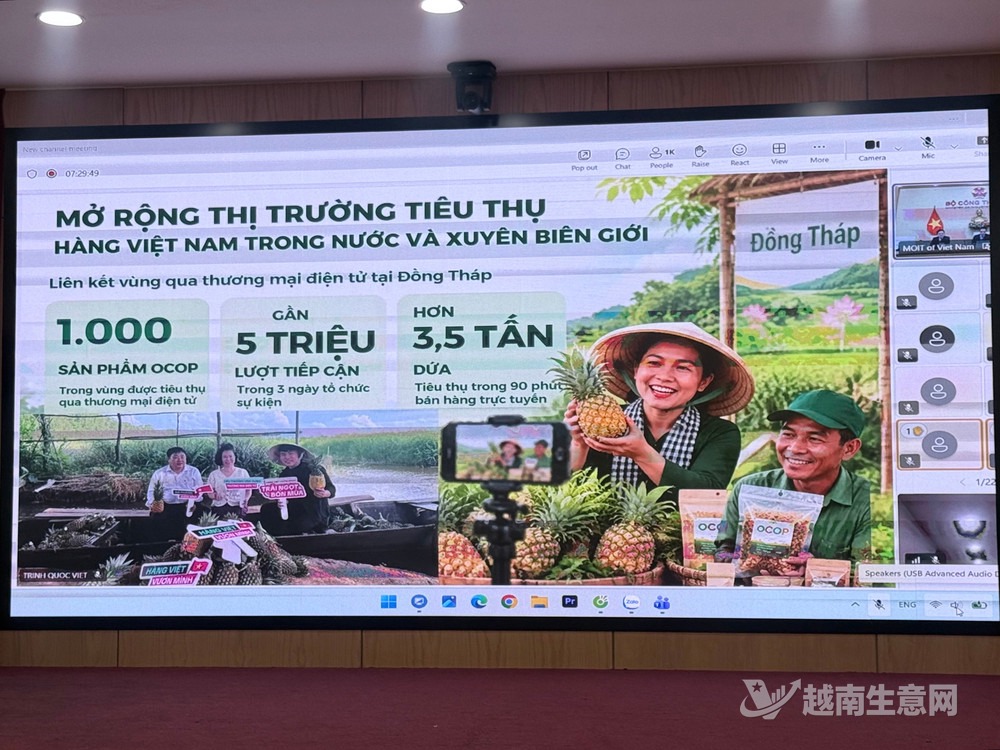
Some localities have begun expanding markets for their products through e-commerce.(VietVance)
TikTok Shop and the Ministry of Industry and Trade’s E-Commerce Department have worked together on a commune and ward e-commerce program since January 2026. TikTok Shop says the program has trained more than 35,000 local sellers and added identification tags to more than 230,000 Vietnamese and One Commune One Product products. Participating sellers’ revenue has grown by an average of 30.5%. According to platform data as of October 31, Bình Lư commune in Lai Châu recorded 9,324 orders, Phượng Dực commune in Hanoi 73,070 orders, and Chợ Lách commune in Vĩnh Long 81,521 orders.
Nguyễn Văn Minh recommended continued tracking of indicators including participants, active shops, completed orders, revenue, business continuity and transaction safety. Nguyễn Việt Sơn said the ultimate measure of success is how many residents in each commune can sell goods independently, how many products gain stable outlets and how much residents’ incomes rise.
Source: VietVance