Vietnam’s Semiconductor Development Focuses on Domestic R&D Capabilities
At a conference in Hanoi on November 17, Vietnamese officials and experts said the semiconductor industry needs to turn investment and policy support into domestic R&D capabilities and commercial products to build lasting competitiveness. They discussed shared research facilities, workforce training and priorities for chip development.

On November 17, Vietnam’s Central Policy and Strategy Commission and the Institute of Generative Intelligence Technology and Education (IGNITE) held a conference on the semiconductor industry in Hanoi. Nguyen Hoang Giang, deputy head of the commission, said Vietnam had gradually trained chip design engineers, established research and training institutions, and attracted businesses and investment projects. However, its domestic capabilities in R&D, product development and participation in higher value added segments remain limited.
Nguyen Hoang Giang said progress in the industry should be assessed on more than the number of businesses and investment projects. Assessments should also examine capabilities in integrated circuit design, specialised chip development, packaging and testing, R&D facilities, and product commercialisation. He proposed linking foreign investment projects with domestic research, workforce training and the development of Vietnamese companies’ technological capabilities, while specifying implementing agencies, resources and performance indicators for priority projects.
Participants suggested studying a cooperation model involving the government, research institutions, businesses, investors and banks. Nguyen Ai Viet, head of IGNITE, called for greater investment in R&D personnel, an inventory and public disclosure of existing semiconductor laboratories, and a shared laboratory network to reduce duplicate investment and improve facility utilisation.
Deputy Minister of Science and Technology Le Xuan Dinh proposed concentrating R&D resources on AI chips, Internet of Things chips, compound semiconductor power chips for green energy, and semiconductor technologies for 5G and 6G communications equipment. He also said research funding should be more directly linked to practical problems and business needs.
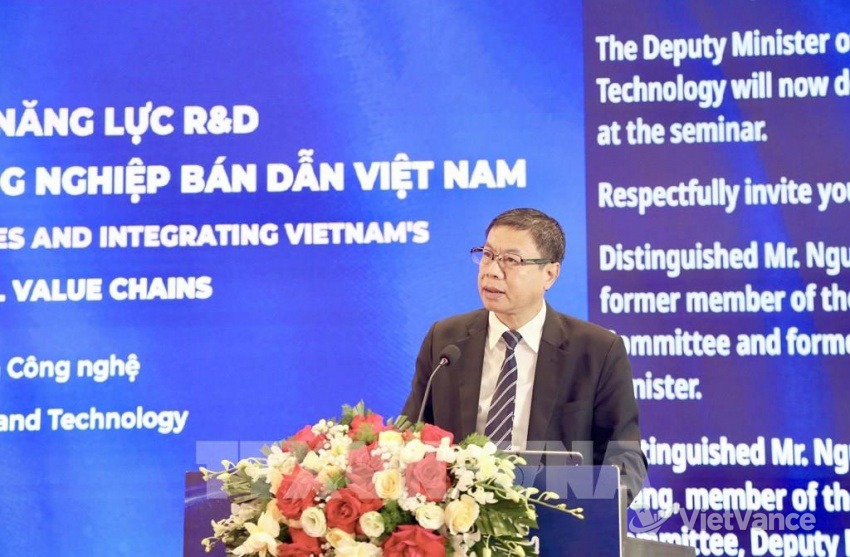
Deputy Minister of Science and Technology Le Xuan Dinh.(VietVance)
Le Xuan Dinh said that, under relevant provisions of Decree No. 260, semiconductor products could receive support covering up to 100% of domestic and international testing costs. The Ministry of Science and Technology also plans to bring a National Centre for Semiconductor Chip Pilot Production Support into operation in the future. It would provide domestic chip design teams with high-performance computing, access to electronic design automation software licences at preferential rates, and shared testing and measurement services.
Source: VietVance