Vietnam Unveils 2026–2030 Trade Surplus Management Plan
On November 21, Vietnam’s government issued a plan to manage trade surpluses and prevent international trade risks from 2026 to 2030. It calls for early warnings on key products and markets, tighter oversight of origin, stronger supply chains and measures to manage production capacity.

Vietnam’s Standing Deputy Prime Minister Phạm Gia Túc signed Resolution No. 403/NQ-CP on November 21, 2026, issuing a comprehensive plan to manage trade surpluses and prevent risks in international trade from 2026 to 2030. The plan calls for stronger imports to support production as exports expand, improved quality and added value in exported goods, and safeguards against risks involving overcapacity, origin fraud, illegal transshipment and forced labor.
The government will regularly monitor the size and structure of trade surpluses and their concentration among products, markets and companies, issuing early warnings about trade barriers and high-risk supply chains. The plan calls for diversifying markets and sources of supply, increasing local content and domestic added value, and reducing dependence on a small number of markets, products and imported inputs.
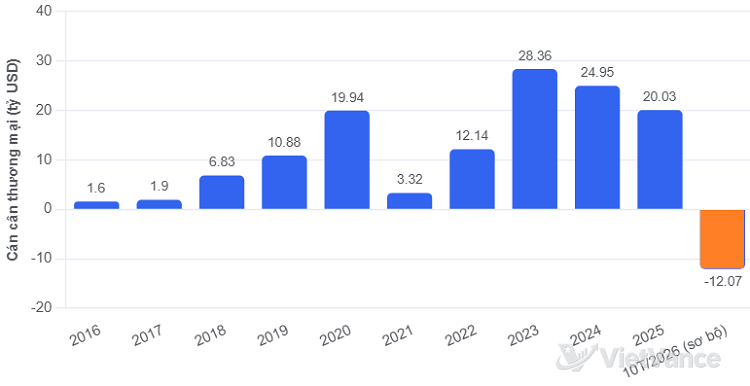
Vietnam’s trade surpluses and deficits from 2016 through the first 10 months of 2026; data source: Statistics Office, Ministry of Finance.(VietVance)
The plan sets out seven groups of key measures, including improving rules on certificates of origin, self-certification and post-clearance checks; linking customs, tax, investment, import and export data; and building databases on origin and supply chains. The government will also develop supporting industries, promote cooperation between foreign-invested and local companies, encourage imports of new equipment and technology, and manage investment and production capacity in line with market demand.

Developing supporting industries and increasing local content are among the plan’s priorities for export supply chains.(VietVance)
The Ministry of Industry and Trade will assess trade surpluses by industry, market and type of company and operate an early warning system. The Ministry of Finance will help analyze customs and investment data and assess the contribution of foreign-invested companies. The Ministry of Industry and Trade will also study revisions to rules on the origin of goods and penalties for commercial violations, upgrade the electronic certificate of origin system, and strengthen checks on origin fraud and illegal transshipment.
Local authorities will review licensed, under-construction and planned projects, including foreign direct investment projects, and assess policies that could prompt disputes over overcapacity or export subsidies. Relevant agencies will also improve mechanisms to identify and investigate goods at risk of being produced with forced labor, strengthen communication with trading partners, and issue early warnings about trade investigations and adverse tariff measures.
Source: VietVance