Vietnam Proposes Studying Ultra-High-Voltage Power Line Costing Nearly $3.5 Billion
Vietnam’s Ministry of Industry and Trade has proposed studying a ±800 kV direct-current transmission line from the South Central Coast to the Red River Delta. The project, estimated to cost nearly $3.5 billion, remains part of a proposed revision to the national power plan under consultation.

In a proposed revision to Power Development Plan VIII that is open for comment, the Ministry of Industry and Trade recommends studying a ±800 kV ultra-high-voltage direct-current transmission line connecting the South Central Coast with the Red River Delta as soon as possible. The line would be about 1,050 kilometers long, with an expected transmission capacity of 6,000–8,000 MW and a preliminary total investment estimate of nearly $3.5 billion. If built, it could become Vietnam’s first ultra-high-voltage direct-current transmission line.
Under the preliminary plan, the converter station at the southern end would receive power from the North Central and South Central Coast regions through the 500 kV grid, convert it from alternating current to direct current, and send it north. At the receiving station, the power would be converted back to alternating current and fed into the northern grid. Vietnam’s north-south power transmission currently relies mainly on four 500 kV alternating-current circuits.
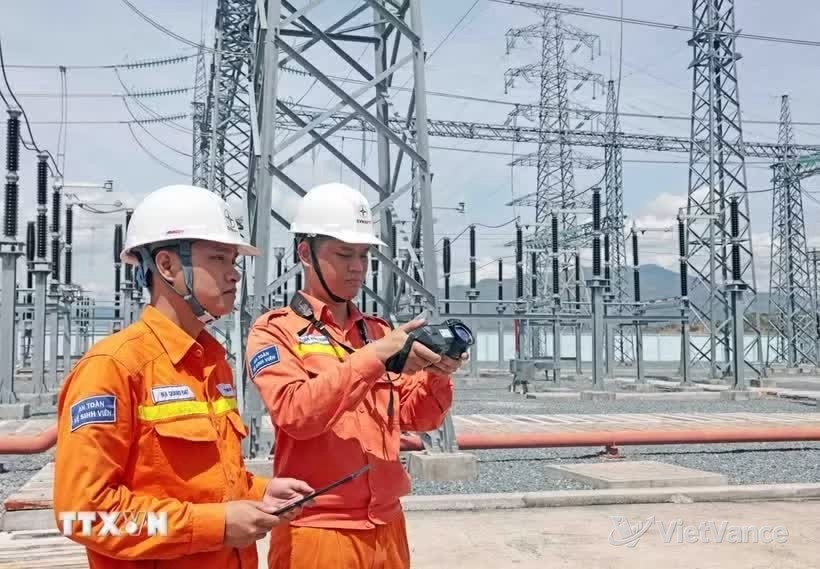
Electricity sector staff monitor a substation.(VietVance)
A preliminary comparison by the Energy Institute shows that the ±800 kV direct-current option would require an investment of about $3.47 billion and have a discounted cost of about $3.6 billion. Both figures are lower than those for the other three direct-current or alternating-current transmission options it studied. The institute said preparation and construction could take 7–10 years and therefore recommended starting research and investment preparations as soon as possible.
The Energy Institute estimates that the amount of electricity transmitted from central to northern Vietnam could rise from 32.8 billion kWh in 2027 to 47.4 billion kWh in 2030. During that period, the 500 kV grid would carry all the additional transmitted electricity. The proposed plan revision also considers adding two 500 kV transmission corridors, one to western Hanoi and the other to Hung Yen.
Demand for power transmission to the north is expected to continue growing after 2030. By 2035, electricity transmitted from central Vietnam to the Red River Delta could reach 90.5 billion kWh. Of that, the 500 kV alternating-current corridor from the North Central region is expected to carry about 45.5 billion kWh, while the proposed ultra-high-voltage direct-current corridor would carry about 45 billion kWh.
Source: VietVance