Israeli Study Uses AI to Predict Health Indicators From Gait
Israeli researchers trained an AI model on three-dimensional movement data from 3,328 adults and found statistically significant links between movement patterns and many health indicators. Gait analysis could supplement health assessments, but the model is not yet ready for clinical diagnosis.

A research team at Israel’s Weizmann Institute of Science has developed an artificial intelligence model that analyzes body movement to predict health indicators across multiple organ systems. The findings were published in Nature Medicine on November 6. The researchers stressed that the method cannot yet be used for clinical diagnosis.
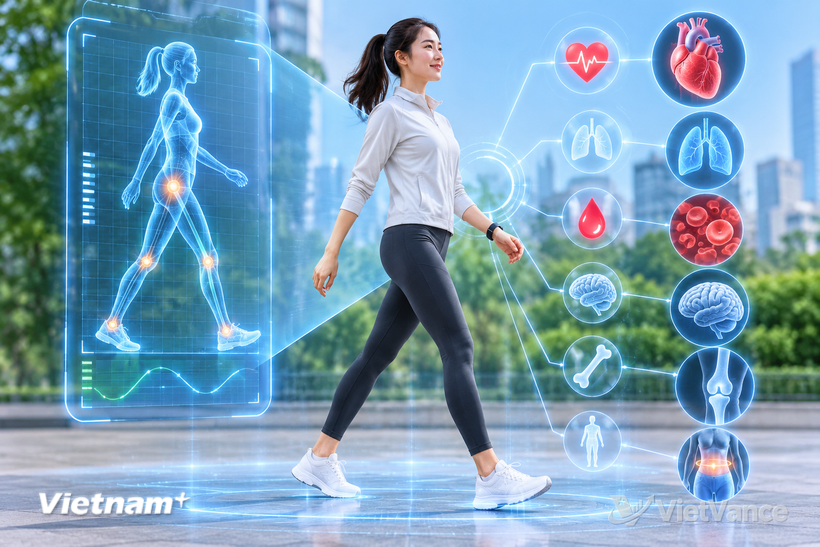
Illustration of human movement analysis.(VietVance)
The study was led by Eran Segal, with Adam Gabet as first author. The team used data from 3,328 adults in a long-term health tracking project in Israel. Each participant completed 5 movement tasks in front of a depth camera, which recorded three-dimensional skeletal movement without markers attached to the body. The team collected 17,589 movement sequences to train the model. Tel Aviv-based Newton VR helped develop the recording system used in the study.
The researchers compared the movement data with 3,210 health indicators and found statistically significant associations with 1,887 of them, or about 59%. The model also outperformed traditional gait measures in predicting age, body mass index and visceral fat levels.
After accounting for age, height, body mass index and visceral fat, movement data still improved predictions for indicators across all 18 organ systems studied in men and 17 in women. The team said movement analysis also improved predictions of liver stiffness and some indicators of metabolism, sleep and mental health. Leg movement contributed substantially to predictions of metabolic health and physical frailty, while upper-body movement provided additional information about sleep and lifestyle.
The researchers believe gait analysis could become a supplementary health indicator that is easy to collect on a large scale. However, the associations found do not establish causation. Before the model can be used clinically, it needs validation through future follow-up studies and data from more diverse populations.
Source: VietVance