Astronomers Discover Quasar More Than 13.1 Billion Years Old
A team led by German scientists has discovered a quasar more than 13.1 billion years old. Its central black hole has a mass about 360 million times that of the Sun, offering new clues to how supermassive black holes formed in the early universe.

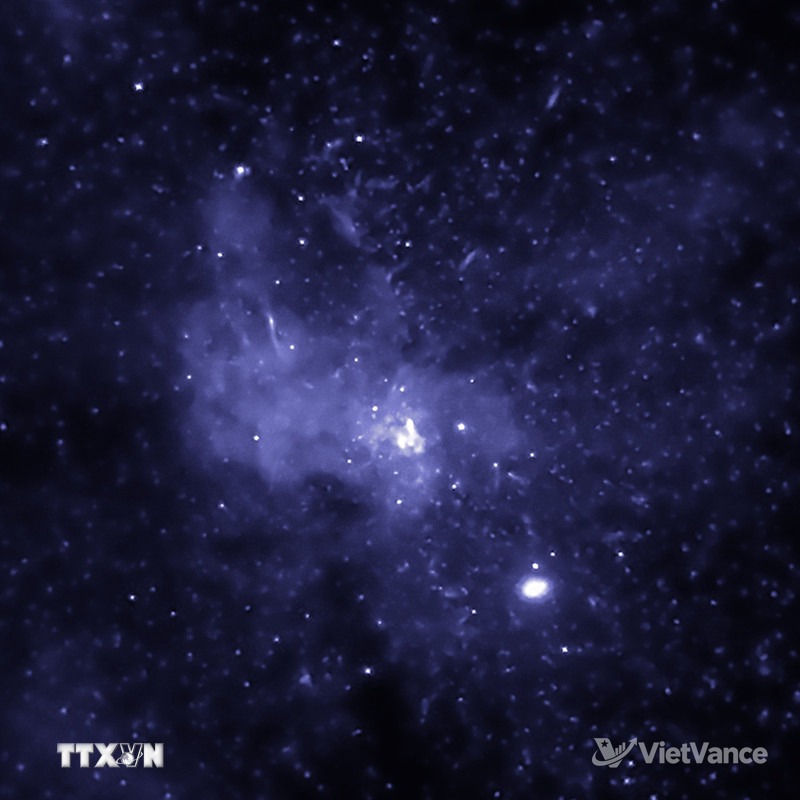
An astronomy team led by German scientists has discovered the most distant quasar ever recorded. The researchers believe it formed more than 13.1 billion years ago, when the universe was about 630 million years old and less than 5% of its current age. The discovery offers clues to the formation and evolution of supermassive black holes in the early universe.
The quasar is nicknamed Dún Aonghasa, after an ancient stone fort in Ireland. A team led by European Southern Observatory astronomer Julien Wolf first detected the object using the European Space Agency’s Euclid space telescope, then confirmed it with data from the Hubble and James Webb space telescopes and other observatories.
A quasar is the extremely bright core of a galaxy, powered by a supermassive black hole at its center. As gas and dust gather around the black hole, they form a hot accretion disk that releases enough energy to shine hundreds or even thousands of times brighter than the rest of the galaxy combined. The study shows that the black hole at the center of the newly discovered quasar has a mass about 360 million times that of the Sun, roughly 90 times the mass of the supermassive black hole at the center of the Milky Way.
Researchers say the black hole’s growth to such a mass just about 630 million years after the Big Bang challenges current understanding of how black holes form and evolve. One hypothesis is that it formed through the direct collapse of a giant gas cloud, rather than growing gradually from the remains of a star. The findings were published in Astronomy & Astrophysics. Researchers believe the Euclid space telescope may discover even more distant quasars in the future.
Source: VietVance