Vietnam Calls on Government Agencies to Disclose AI Needs to Involve Domestic Firms
Vietnamese Deputy Prime Minister Hồ Quốc Dũng has called on ministries, agencies and local authorities to disclose priority AI problems, available data, procurement needs and projected budgets so domestic firms can take part. The government also plans to expand AI use in public services and assess implementation results.

On November 25, Vietnam’s Central Policy and Strategy Commission, Ministry of Science and Technology and other agencies held a forum on implementing the national digital architecture and national artificial intelligence strategy. Deputy Prime Minister Hồ Quốc Dũng called on ministries, agencies and local authorities to disclose priority AI problems to create opportunities for Vietnamese companies to develop and provide solutions.
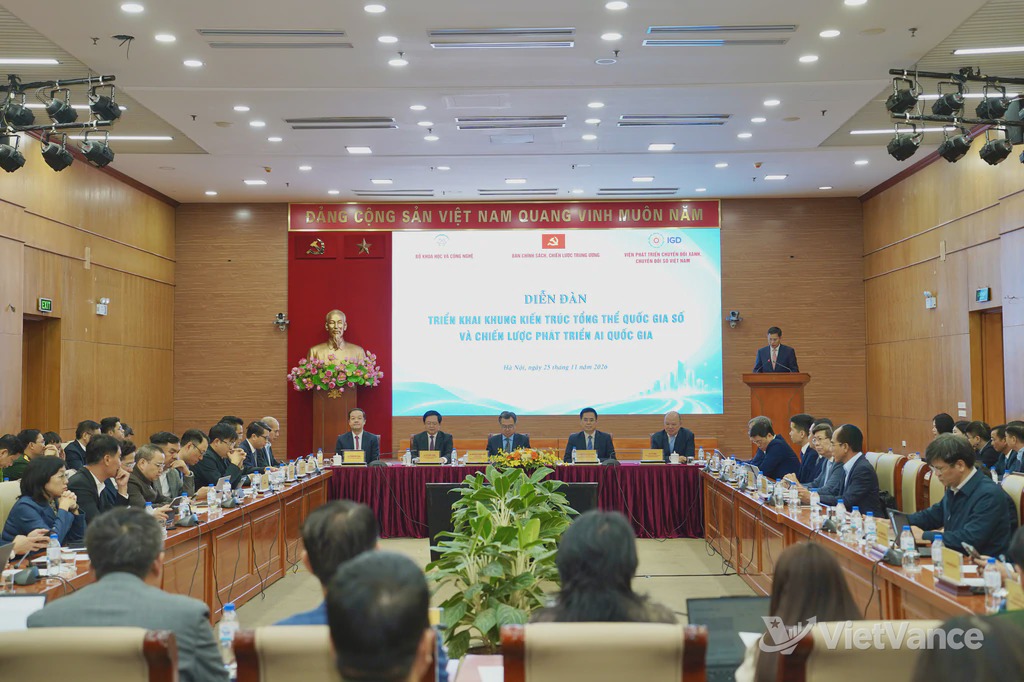
The forum on implementing the national digital architecture and national artificial intelligence strategy.(VietVance)
Hồ Quốc Dũng said the state should be a major customer and among the first users of AI products developed by Vietnamese companies. Ministries, agencies and local authorities should publish data available for use, service rental and procurement needs, and projected budgets so companies can participate in research, development and supply. Implementation should prioritize service rental and public-private partnerships while avoiding dependence on a single platform or supplier.

Vietnamese Deputy Prime Minister Hồ Quốc Dũng speaks at the forum.(VietVance)
For government applications, he called for a national AI platform to support public administration, focusing on four areas: assistants for public officials, public services, institutional development, and administrative direction and decision-making. The relevant data should meet requirements for accuracy, completeness, consistency and sharing, and align with the national data and cybersecurity architectures. Agency heads must take direct responsibility for their organizations’ digital architecture and AI strategy implementation plans.
He also called on the Ministry of Science and Technology to complete guidance on building digital architectures and performance indicators, put the national digital architecture management system into operation, and establish indicators to assess the extent of AI transformation. Deputy Minister of Science and Technology Phạm Đức Long said some information systems remain fragmented and poorly connected, data is not being used efficiently, and AI adoption has yet to deliver productivity gains commensurate with the investment.
Vietnam’s national artificial intelligence strategy sets targets for 2030: all officials, civil servants and public employees will use a public administration AI platform every week; 60% of administrative direction and decision-making will be supported by data and AI; all online public services and administrative procedure applications will receive AI support; and at least five national shared AI platforms will be developed.
Source: VietVance