Japan–Europe Probe Enters Mercury Orbit
The European Space Agency confirmed that the jointly developed BepiColombo probe entered Mercury orbit on November 22, 2026, after an eight-year journey of more than 10 billion kilometers. Its European and Japanese spacecraft are scheduled to separate on December 9–10 to study Mercury’s surface and magnetic field.

The European Space Agency confirmed that BepiColombo, a probe jointly developed by Japan and Europe, completed its orbital insertion maneuver on November 22, 2026, and entered orbit around Mercury. The probe fired its thrusters for more than 30 minutes and has begun analyzing the data it collected. The orbital insertion marks the start of the mission’s detailed study of Mercury.
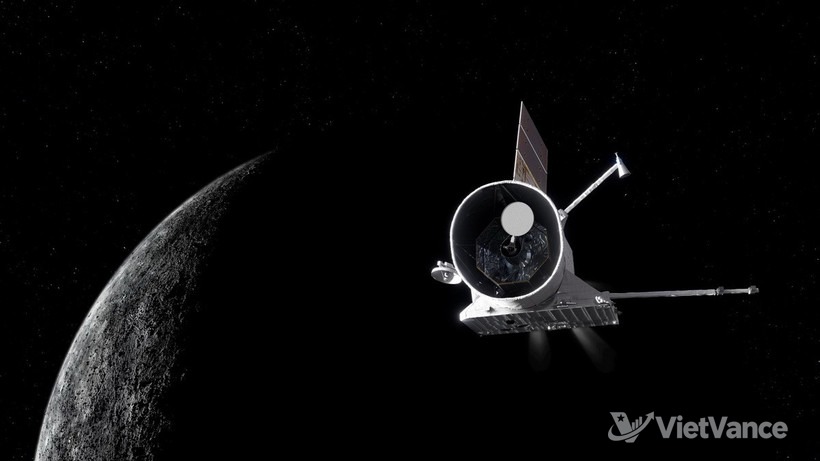
Illustration of the joint European and Japanese BepiColombo mission to Mercury.(VietVance)
Launched in 2018, BepiColombo has a mass of about 4 metric tons. During its eight-year journey, it traveled more than 10 billion kilometers and used gravitational assists from flybys of nine celestial bodies before reaching the smallest planet in the solar system and the one closest to the Sun.
The European and Japanese spacecraft are scheduled to separate on December 9–10, 2026, and enter their respective orbits. The European spacecraft will study Mercury’s surface from an altitude of about 480 kilometers; the Japanese spacecraft will study its magnetic field from an elliptical orbit that will take it as far as about 11,000 kilometers from the planet.
Mercury remains one of the least explored planets in the solar system. Its surface temperatures range from minus 180 to 450 degrees Celsius, and it is frequently exposed to intense solar radiation. Scientists expect BepiColombo’s data to help clarify Mercury’s internal structure, surface features and magnetic field, improving understanding of the formation and evolution of the solar system. Previously, NASA’s Mariner 10 became the first probe to fly past Mercury in 1974.
Source: VietVance