Chinese Memory Chipmakers Expand Production as Global Competition Intensifies
AI is driving demand for memory chips, prompting CXMT and YMTC to expand capacity, improve their technology and gain share in global DRAM and NAND markets. Their ability to produce at scale and the technology gap in advanced products still constrain their competition with industry leaders.

Growing demand from AI servers and data centers is expanding the market for DRAM and NAND memory chips. Chinese companies ChangXin Memory Technologies (CXMT) and Yangtze Memory Technologies (YMTC) are using the opportunity to expand production and advance their technology, intensifying competition with Samsung Electronics, SK hynix and Micron.
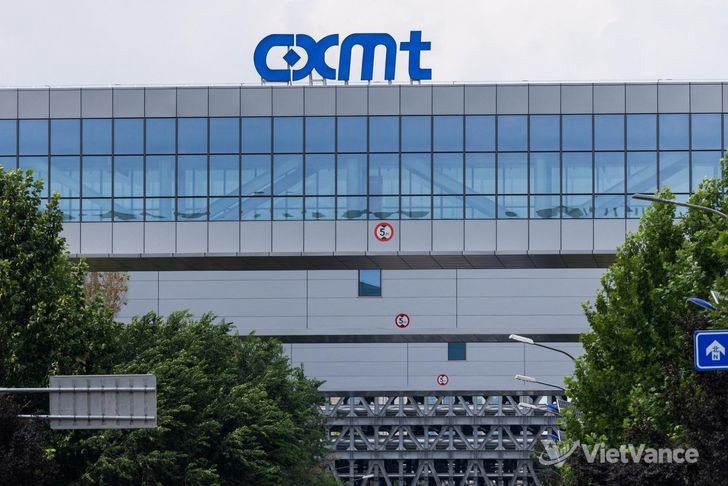
The CXMT logo on the exterior of the company's production facility in Beijing, China.(VietVance)
CXMT primarily produces DRAM. According to market research firm Counterpoint Research, CXMT accounted for 9% of global DRAM revenue in the third quarter of 2026, up from 5% a year earlier. The company says it has begun mass production using its fifth-generation DRAM process. Its sixth-generation 4F2 design is still undergoing sample validation, and it plans to provide customers with samples of server memory modules using the technology by the end of 2026.
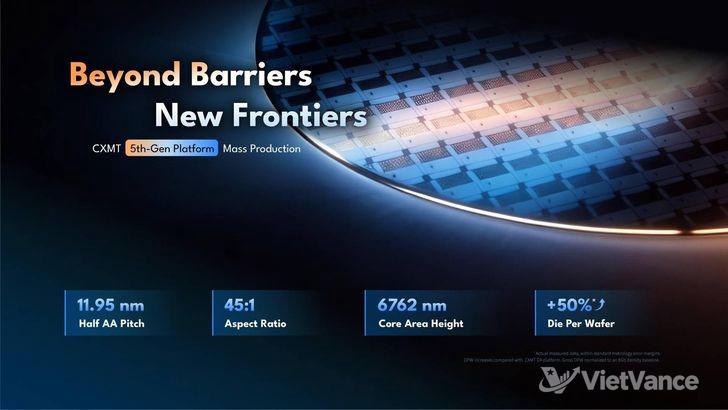
A display of CXMT's fifth-generation DRAM technology platform and related products.(VietVance)
YMTC focuses on NAND flash memory. In the second quarter of 2026, it ranked third globally by shipments, with a 16.5% share. Its Xtacking technology manufactures memory cells and control circuits on separate wafers and then connects them to improve storage density and data transfer speeds.
The YMTC logo and a computer motherboard.(VietVance)
Technological advances still need to translate into stable, cost-competitive production at scale. Nomura expects CXMT's 4F2 chips to reach large-scale commercial production only in 2027–2028. A sizable gap also remains in advanced high-bandwidth memory, while YMTC is still about one generation behind leading manufacturers in the number of memory layers in its high-end NAND products.
One key to future competition is whether the companies can enter overseas customers' supply chains. Counterpoint Research forecasts that server-related products will contribute nearly 39% of YMTC's revenue by 2028. At the same time, if AI demand slows after new capacity comes online, the conventional DRAM market could face more intense price competition.
Source: VietVance