Ho Chi Minh City’s Tidal Flood Control Project Set to Operate on November 30
Ho Chi Minh City’s tidal flood control project, costing more than VND 10 trillion, is scheduled to begin operating on November 30, 2026. Covering about 570 square kilometers and an estimated 6.5 million people, it uses tidal gates, embankments and automated controls to manage tides and improve rainwater drainage.

After about a decade of development, the first phase of Ho Chi Minh City’s tidal flood control and drainage project is scheduled to begin operating on November 30, 2026. With total investment exceeding VND 10 trillion, it is designed to cover about 570 square kilometers and a population of approximately 6.5 million. The project takes climate change into account and aims to reduce flooding caused by tidal backflow while improving rainwater drainage in urban areas.
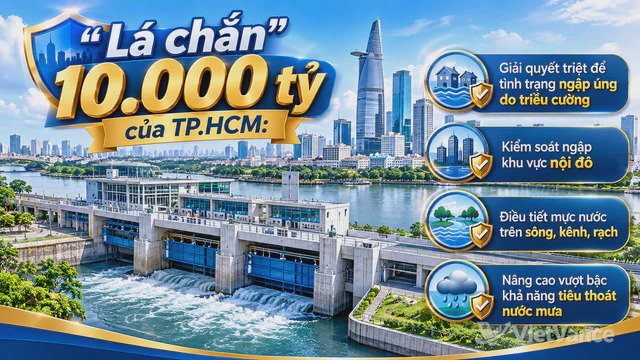
Illustration of the first phase of Ho Chi Minh City’s tidal flood control and drainage project and its effects on residents and the environment. Created using artificial intelligence.(VietVance)
The project includes six large tidal gates with openings 40 to 160 meters wide, as well as two medium gates and 43 small gates with openings 10 to 25 meters and 1 to 10 meters wide, respectively. About six kilometers of embankments and bank protection have also been built along vulnerable sections of the Saigon River. Together, these structures form a tidal flood control system.
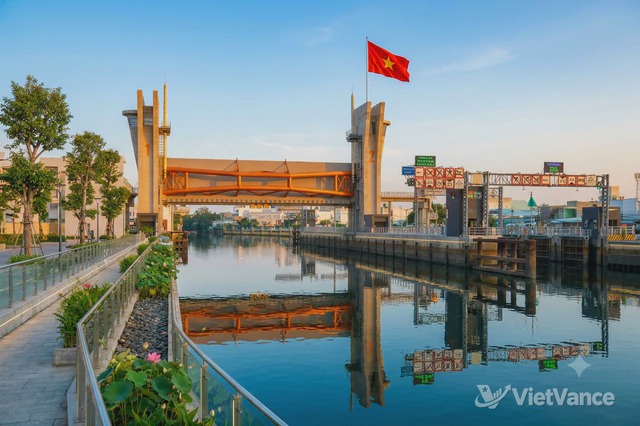
Phú Định tidal gate in Ho Chi Minh City; the original photo was edited using artificial intelligence.(VietVance)
The project uses a supervisory control and data acquisition (SCADA) system to connect monitoring equipment with a central management facility and control the gates according to tidal levels and rainfall. When river tides rise, the gates close to prevent river water from entering urban waterways. When water levels outside the city fall below those inside, the gates open to drain accumulated water into the river while maintaining waterway access.
The project also aims to reduce saltwater intrusion farther inland and improve water quality by increasing water flow and restoring the banks of canals and waterways. Whether it achieves these outcomes will depend on its performance after it begins operating.
Source: VietVance