Japanese rubber futures fall for second day as Vietnam purchase prices hold steady
On November 9, December rubber futures on the Osaka Exchange fell 0.7%, while the January 2027 contract on the Shanghai Futures Exchange edged up. Lower oil prices and improved weather in producing regions weighed on the rubber market. Purchase prices reported by Vietnamese companies remained stable.

At the close on November 9, December rubber futures on Japan’s Osaka Exchange fell 2.9 yen, or 0.7%, to 411.9 yen per kilogram, declining for a second consecutive trading day. January 2027 rubber futures on the Shanghai Futures Exchange rose 50 yuan to 18,670 yuan per tonne. Thailand’s RSS3 rubber export offer was unchanged at 92.4 baht per kilogram.
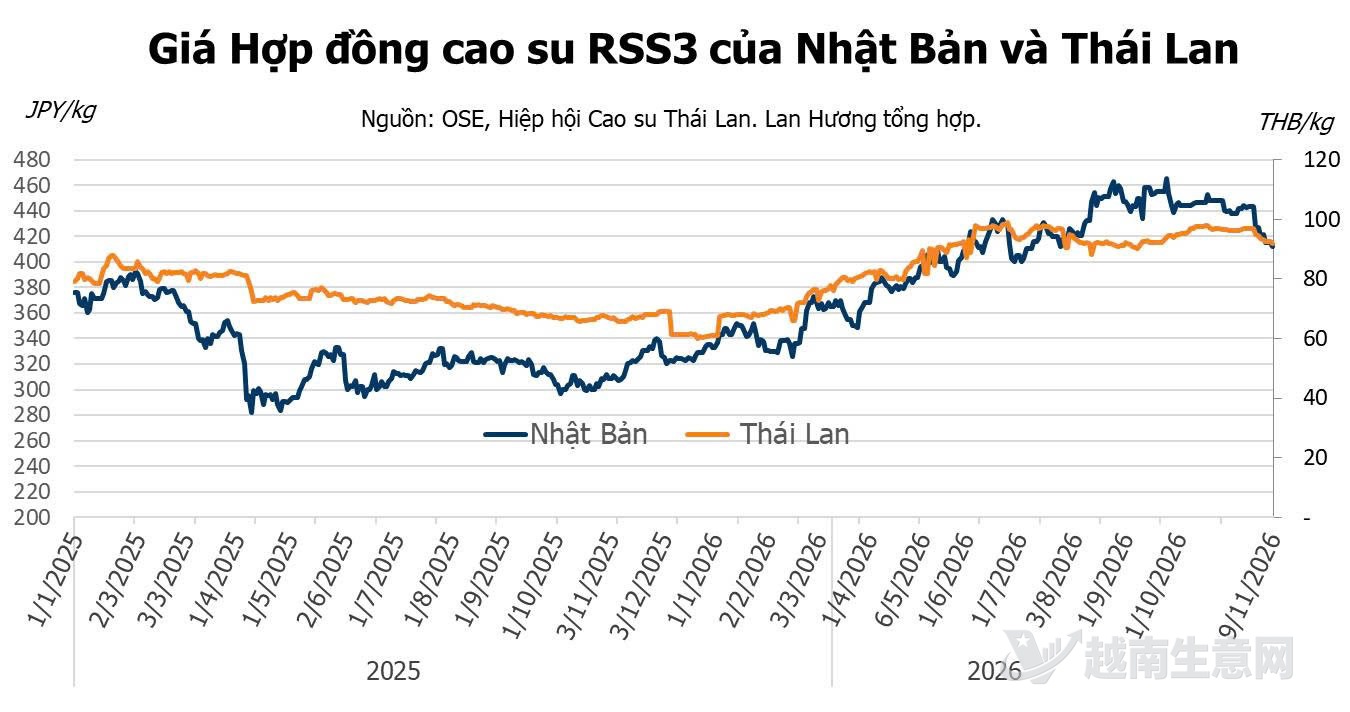
Trends in rubber futures prices in Thailand and Japan.(VietVance)
Japan Exchange Group said on November 9 that improved weather in major producing areas of Thailand and other ASEAN countries was helping rubber output recover; falling oil prices and weaker global equities also weighed on market sentiment. Data released by the Shanghai Futures Exchange on November 6 showed that rubber inventories in warehouses it monitors had fallen 4.6% from the previous week.
In Vietnam, Bình Long Company’s rubber purchase price at its factory was 540 Vietnamese dong per TSC degree per kilogram, while its production teams paid 530 Vietnamese dong per TSC degree per kilogram; the price of mixed latex held steady at 18,000 Vietnamese dong per kilogram. MangYang Company’s purchase price for fresh latex was 458 to 463 Vietnamese dong per TSC degree, while mixed coagulated latex fetched 404 to 459 Vietnamese dong per DRC degree. Both prices remained stable.
Rising raw material costs have affected downstream tyre makers. India’s Apollo Tyres reported a 17% year-on-year increase in consolidated revenue for the quarter ended September 30, while operating profit fell 15.8%. The company said its natural rubber costs rose about 25% to 26% year on year during the quarter; by the end of October, cumulative price increases across several tyre categories in India had reached 13% to 15%.
Source: VietVance