
How Options Hedge Stock Risk: Buyers Pay a Premium, Sellers Take on Obligations
Option buyers pay a premium for the right to buy or sell an underlying asset within a specified period; sellers receive the premium and take on the corresponding obligation. Hypothetical examples show how buying put options can reduce losses in a falling stock portfolio, though the effectiveness of the hedge depends on the contract terms and how closely the portfolio tracks the underlying asset. Buyers and sellers face markedly different risks.

An option gives its buyer the right to buy or sell an underlying asset at an agreed price within a specified period. The buyer pays a premium; the seller who opens the position receives it and assumes the obligation to perform under the contract’s terms. Buying a call option can provide exposure to a rising market, while buying a put option can help address a decline or protect an existing stock portfolio.
Options can be used for investment and stock portfolio risk management.(VietVance)
The article uses a hypothetical stock index to illustrate returns and costs: the index stands at 1,000 points, with each point worth VND 100,000. An investor buys a call option with a strike price of 1,000 points, paying 40 points, or VND 4 million. If the index reaches 1,020 points at expiration, the investor still loses VND 2 million after the premium; it must reach 1,040 points to break even before other costs. Even a correct forecast of a rise can result in a loss if the increase is too small.
Under the same assumptions, buying a put option with a strike price of 1,000 points to protect a VND 100 million stock portfolio that moves in proportion to the index costs VND 3 million. If the index falls to 900 points, the portfolio’s value drops to VND 90 million and the option pays VND 10 million, leaving a total value of VND 97 million after the premium. If the index rises to 1,100 points, the total value is VND 107 million.
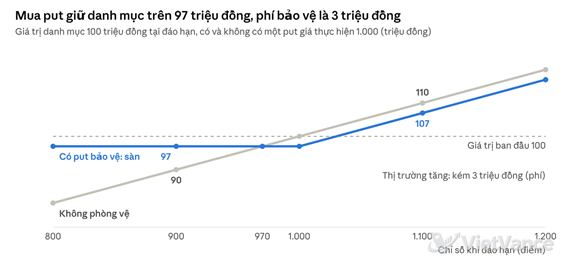
The hypothetical example shows the value of a stock portfolio protected by a purchased put option at different index levels.(VietVance)
A seller’s risk cannot be judged solely by the premium received. For example, a seller who receives VND 4 million for writing the call option described above must pay VND 10 million if the index reaches 1,100 points at expiration, resulting in a net loss of VND 6 million. Margin secures performance; it is not the seller’s maximum loss. An adverse market move may also require additional margin.
A call option’s profit or loss at expiration depends on whether the index’s rise is enough to cover the premium.(VietVance)
These figures illustrate the mechanics only. They are not quotes for a specific product traded in Vietnam and exclude taxes, fees and other costs. The effectiveness of a hedge also depends on the strike price, term, contract size and how closely the stock portfolio tracks the option’s underlying asset. Before expiration, an option’s price is also affected by the time remaining and expected volatility, so a calculation of the payoff at expiration alone cannot determine the outcome of a trade.
Source: VietVance