Trump Confirms He Did Not Meet Kim Jong Un During China Visit
US President Donald Trump said on November 19 that a busy schedule prevented him from meeting North Korean leader Kim Jong Un during his trip to China for the APEC leaders’ meeting. Trump said they remain on good terms and could meet in the future. No time, place or agenda has been confirmed for a new meeting.

US President Donald Trump confirmed on November 19 that he did not meet North Korean leader Kim Jong Un during his trip to China for the APEC leaders’ meeting, but remained willing to engage in dialogue with North Korea in the future. In a telephone interview with NBC as he left Shenzhen, China, for the United States that day, Trump said the meeting they had hoped for did not take place because the summit schedule was too busy.
Trump said he and Kim remain on good terms and could meet at another time. Before visiting China, Trump had repeatedly expressed a desire to meet Kim, including the possibility of talks during events in China. He had also said he was willing to resume dialogue with North Korea to seek a solution to the nuclear issue on the Korean Peninsula.
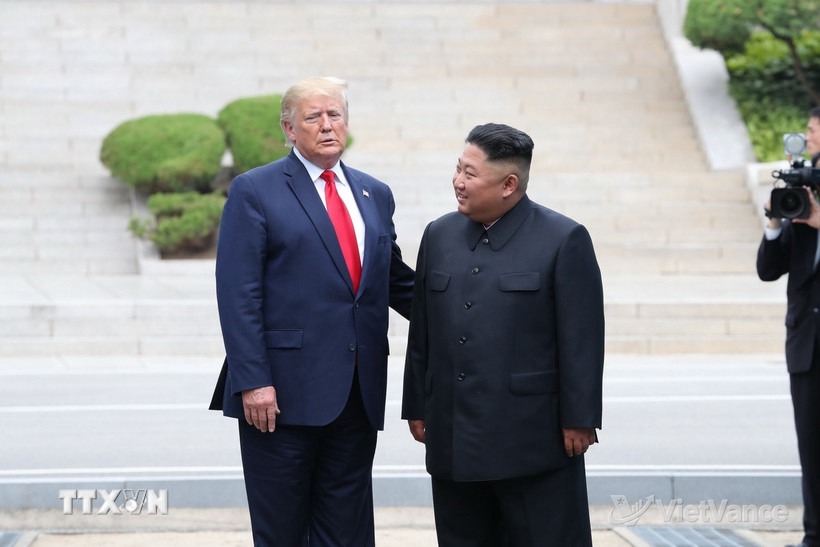
Trump (left) and Kim Jong Un met at Panmunjom on the border between North and South Korea on June 30, 2019.(VietVance)
US Secretary of State Marco Rubio previously said Washington was seriously considering resuming high-level contact with North Korea. However, there has been no confirmation that the two sides have agreed on a time, place or agenda for a new meeting. North Korea has also made no official response to the proposal for a meeting during Trump’s China visit.
Trump’s China visit ended without the direct meeting between the two leaders that observers had anticipated. Observers say the prospects for resuming dialogue depend largely on whether the two sides can narrow their differences over North Korea’s nuclear program and the conditions for negotiations. As North Korea continues to strengthen its ties with Russia and China, changes in US policy toward North Korea will continue to affect security in Northeast Asia.
Source: VietVance