Vietnam Airport Terminal’s 5,300-Ton Steel Roof Lifted into Place
On April 4, 2025, the central steel roof of a terminal at an international airport under construction in Vietnam was lifted into position. Weighing about 5,300 tons and covering nearly 20,000 square meters, it was raised using 56 hydraulic jacks, with 3D scanning and load monitoring helping control installation accuracy.

On April 4, 2025, the central steel roof of a terminal at an international airport under construction in Vietnam was lifted into its design position. The roof weighs about 5,300 tons and has a curved, arched structure covering nearly 20,000 square meters, including a cantilever extending 41 meters outward. The Ministry of Construction said the lift was critical to the construction schedule for the terminal’s Package 5.10 and the project as a whole.
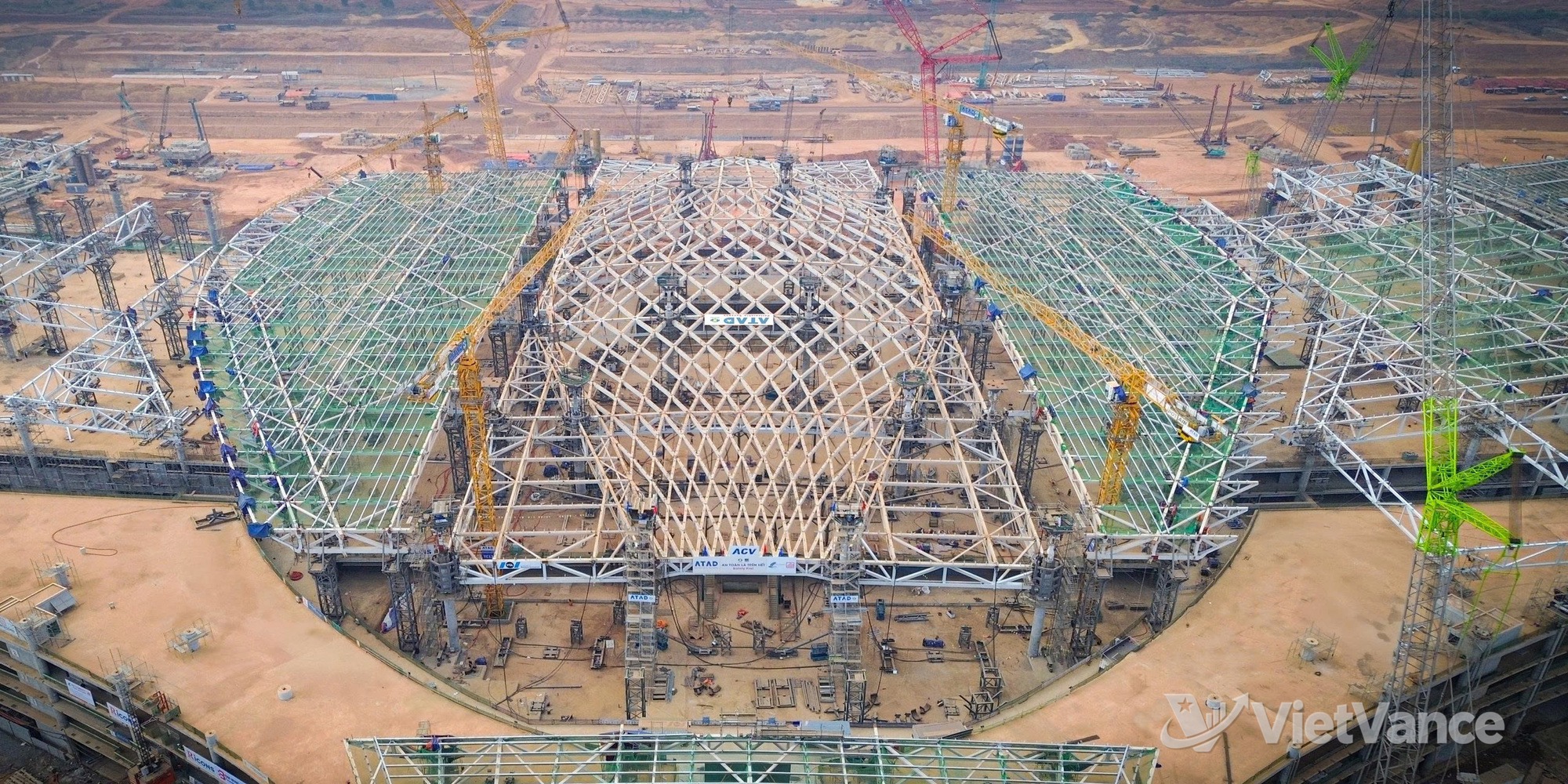
Illustration of steel structure construction at an airport terminal.(VietVance)
The contractor first assembled large steel modules on the ground, then raised them using 56 specialized hydraulic jacks in a process combining pulling and pushing. Each jack has a load capacity of 40 to 330 tons. The steel structure has 256 connection points. Positioning the final 300 millimeters took one day, and the vertical deviation at the welded connections was required to be no more than 5 millimeters.
The lift was suspended on the first day because of heavy rain. On the second and third days, the steel structure was raised about 300 millimeters, after which the contractor checked it for deformation and stability. Subsequent lifts of about 5 to 5.5 meters were followed by pauses for adjustment, reinforcement and safety monitoring, until the roof reached its design position at a height of 16.8 meters. At the peak of the operation, 30 Vietnamese engineers and about 80 workers took part.
The project management team and engineers from the Vietur–ATAD consortium spent 12 months studying the technical plan before construction. The contractor also used a load monitoring system, lifting simulation software, 3D scanning and building information modeling to control the accuracy of component fabrication and installation. During the lift, ATAD engineers worked with experts from Switzerland’s VSL Group.
Source: VietVance