
Vietnamese Index Option Spreads: Limiting Losses and Gains
Index option spreads let investors take positions on moderate market rises or falls at a lower net premium while defining their maximum gains and losses at expiry. Even when the market moves in the predicted direction, an insufficient move, time decay, option pricing or trading costs can still lead to a loss.

When investors expect the VN30 index to rise moderately, they can buy a call option with a lower strike price and sell a call option with the same expiry and a higher strike price. If they expect a moderate decline, they can buy a put option with a higher strike price and sell one with a lower strike price. The premium received from selling the option offsets part of the purchase cost but also limits potential gains.

Illustration of an index option spread strategy.(VietVance)
For these two spreads, which require a net premium payment, the maximum loss is the net premium paid, while the maximum gain is the difference between the strike prices minus that premium. In the article’s example of a one-month call spread with the VN30 index at 2,000 points, the net premium is 50 points, 37.5% below the 80 points required to buy the corresponding call alone. The break-even level at expiry falls from 2,080 to 2,050 points, while the maximum gain is 100 points.
Investors can also use spreads that generate a net premium. Their maximum gain is limited to the net premium received, while their maximum loss is the difference between the strike prices minus that amount. Position size should be based on the maximum affordable loss: with a VND 1 billion portfolio, a 2% risk limit per market view equals VND 20 million. If each spread contract has a maximum loss of VND 5 million, the investor should open no more than four contracts.
Predicting the direction correctly can still result in a loss. If the VN30 reaches 2,040 points at expiry, the call spread described above still loses 10 points because the index has not reached the 2,050-point break-even level. Options also face time-value decay, declines in expected volatility, and costs arising from bid-ask spreads and limited liquidity. Even if the index reaches its target, a subsequent reversal could erase unrealized gains if the position is held to expiry.
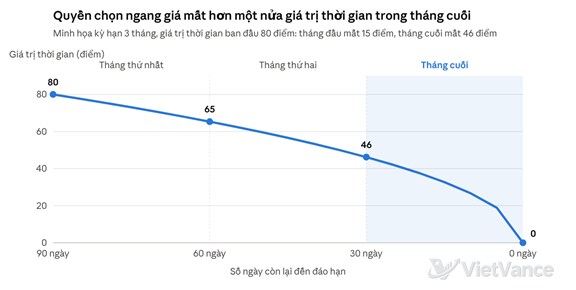
Illustration of how option time value decays faster as expiry approaches.(VietVance)
The article advises investors to decide first whether they aim to hedge or generate returns, then assess their target price, affordable loss, time horizon and position size. Once index options are introduced in Vietnam, strategy selection will still need to reflect market scenarios and risk tolerance.
Source: VietVance