Low Emission Rice Cultivation Expands in Vietnam’s Mekong Delta
Three years into Vietnam’s plan for 1 million hectares of high quality, low emission rice, more than 420,000 hectares had adopted all or part of a sustainable production process by September 2026. Pilot projects show that lower seed, fertilizer and water use can raise farmers’ profits, but irrigation, market links and financing remain obstacles to expansion.

Three years into Vietnam’s plan to cultivate 1 million hectares of high quality, low emission rice in the Mekong Delta, rice farming is gradually shifting toward higher quality, lower input use and reduced emissions. According to the Ministry of Agriculture and Environment, by September 2026, 420,813 hectares had adopted all or part of a sustainable production process, including 67,648 hectares that met all its standards. More than 175,000 households had registered to participate.
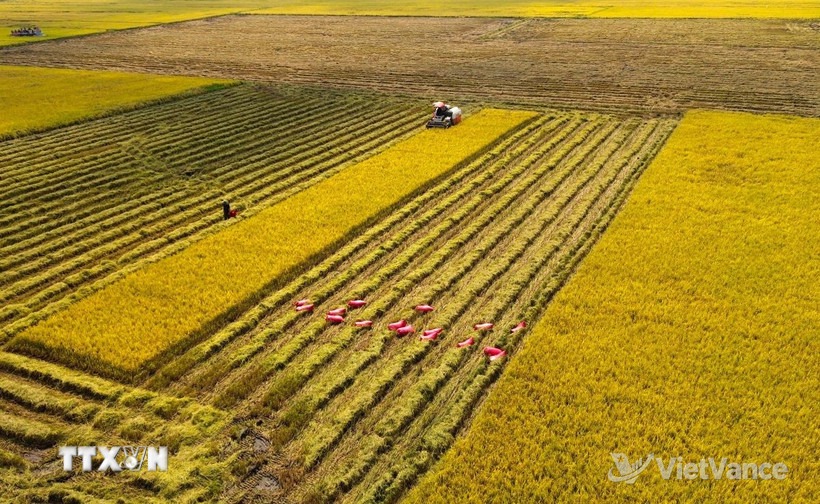
Farmers in Tây Ninh harvest high quality rice for sale through a value chain.(VietVance)
The Ministry of Agriculture and Environment said the process can reduce seed use by 30% to 50%, chemical fertilizer use by 20% to 30% and irrigation water use by 20% to 40%, while increasing yields by 5% to 12%. Profit rises by about 1.5 million to 9.3 million Vietnamese dong per hectare per crop. Estimated emissions reductions in pilot projects are about 3 to 4 tonnes of carbon dioxide equivalent per hectare per crop, depending on ecological conditions, the growing season and how fully the techniques are applied.
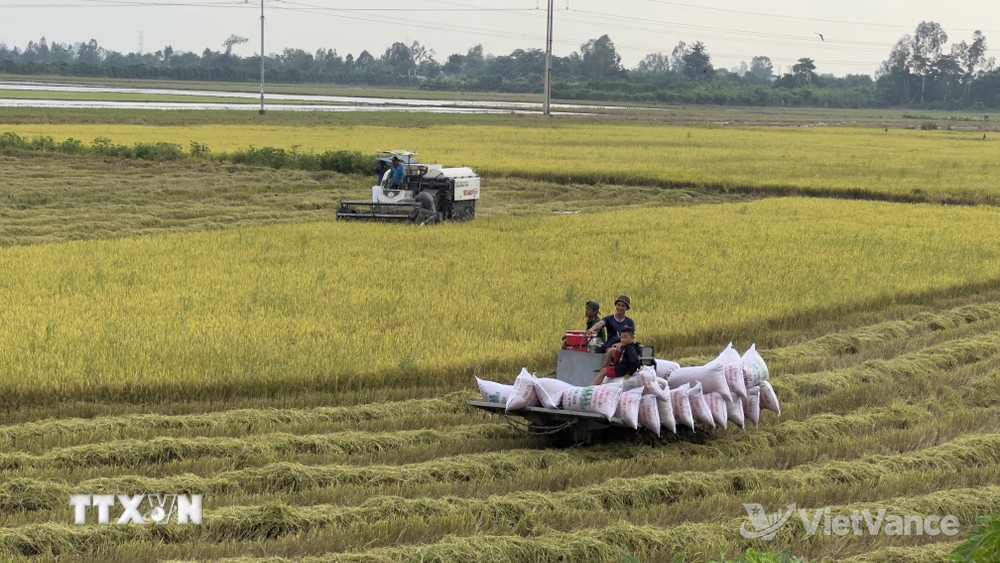
Farmers in An Giang harvest rice grown under the plan for 1 million hectares of high quality, low emission rice.(VietVance)
Low emission farming demonstrations have continued to expand: seven projects covered 302 hectares in 2024, rising to 39 projects covering 1,950 hectares in 2025. In the 2026 summer–autumn crop, more than 376 projects covering 67,648 hectares met all the sustainable production standards. The 97 members of Nam Quý Cooperative in An Giang province use a combined rice, shrimp and crab production model on about 157 hectares. Cooperative director Phạm Chí Thương said that since 2020, members have shifted from growing two rice crops a year to one rice crop and one season of shrimp and crab farming.
Expansion remains constrained by irrigation infrastructure and links between production and sales. Hoàng Văn Hồng, deputy director of the National Agricultural Extension Centre, said alternate wetting and drying requires farmers to be able to control water supply and drainage in their fields. Inadequate irrigation systems prevent farmers from following the full process. Some cooperatives have limited capacity to organize production and unstable partnerships with businesses; straw collection and sales also face difficulties.
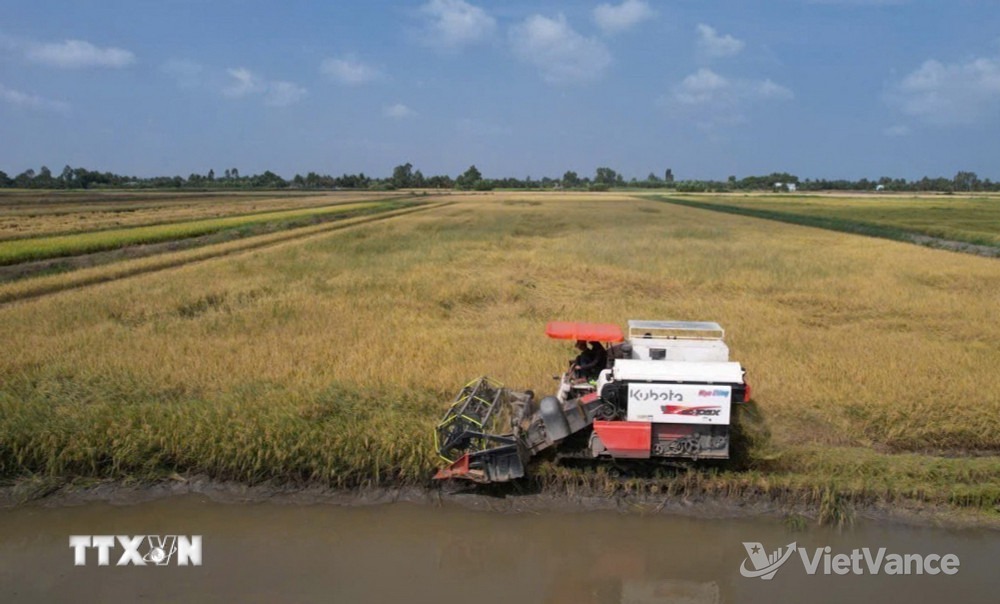
Farmers in Cà Mau use machinery to harvest high quality, low emission rice.(VietVance)
Phạm Chí Thương said the cooperative still lacks facilities to treat wastewater from rice and shrimp farming. Shrimp and crabs are sold mainly through traders, leaving prices unstable. Trần Đại Nghĩa, a climate finance expert with the United Nations Food and Agriculture Organization in Vietnam, said the shift to low emission rice farming requires substantial investment that current funding cannot meet. Fragmented agricultural production and high risks also make private financing harder to obtain.
Source: VietVance