Vietnam’s Average Black Pepper Price Fell 5.3% Year on Year in Q3
In the third quarter of 2026, Vietnam’s average domestic black pepper price was 137,333 Vietnamese dong per kilogram, down 1.7% from the previous quarter and 5.3% year on year. Pepper exports fell in volume and value from the second quarter but remained above year-earlier levels. Ample supplies from Brazil and Cambodia, along with the prolonged conflict in the Middle East, weighed on prices.

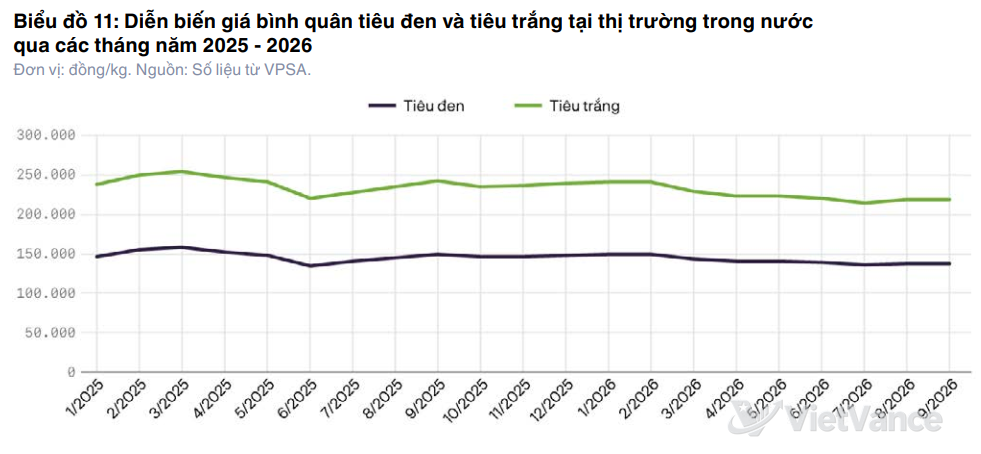
Vietnam’s domestic pepper prices remained under pressure throughout the third quarter of 2026. Black pepper averaged 137,333 Vietnamese dong per kilogram, down 1.7% from the second quarter and 5.3% year on year; white pepper averaged 217,667 Vietnamese dong per kilogram, down 2.1% and 7.5%, respectively. The prolonged conflict in the Middle East and ample supplies from Brazil and Cambodia were the main reasons prices failed to rise.
An image accompanying coverage of Vietnam’s pepper market in the third quarter of 2026.(VietVance)
Vietnam exported 70,653 tonnes of pepper in the third quarter, worth US$460 million, down 11.5% in volume and 11.4% in value from the second quarter, when supply increased after the harvest. Compared with the same period in 2025, export volume rose 11.7% and export value rose 10.1%.
Data from the Vietnam Pepper and Spice Association (VPSA) show that Vietnam imported 48,654 tonnes of pepper in the first nine months of 2026, up 34.7% year on year. Imports have slowed recently, reaching 7,890 tonnes in the third quarter, down 63.2% from 21,456 tonnes in the second quarter.
Global pepper supply is expected to decline slightly in 2026, while import demand has grown in markets including the United States, China, the Netherlands, France and Thailand. Some of the increase, however, reflects inventory replenishment and cannot be attributed entirely to growth in actual consumption. In the third quarter, black pepper prices in most producing countries fell both quarter on quarter and year on year, while Brazil continued to supply the market at competitive prices. Pepper prices are expected to remain relatively stable in the fourth quarter. Increased supply from Brazil could add competitive pressure, while import demand and transportation costs could support prices.
Source: VietVance