Vietnam’s Wood Chip Exports Fall by Volume but Rise in Value as Processors Face Raw Material Pressure
In the first nine months of 2026, Vietnam’s wood chip export volume fell 6.6% year on year, while export value rose 14.4% and the average export price climbed 19.3%. China remained the largest market. Some wood product processors say large scale wood chip exports are worsening shortages of large diameter timber for further processing and have proposed a higher export tax and quotas in areas facing raw material shortages.

Forest Trends’ November 2026 report, compiled from Vietnam Customs data, shows that Vietnam exported 11.8 million tonnes of wood chips in the first nine months of the year, down 6.6% year on year, while export value reached US$2.1 billion, up 14.4%. The average FOB export price over the same period was US$175.2 per tonne, up 19.3% year on year, with higher prices offsetting the decline in export volume.
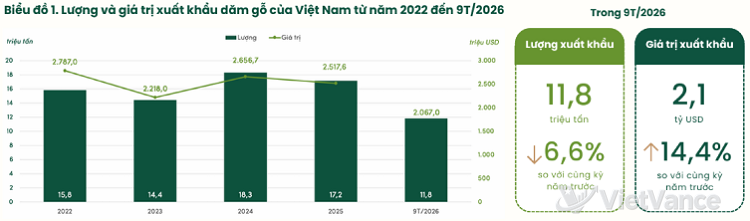
Vietnam’s wood chip exports from 2022 to 2026. Chart source: Forest Trends.(VietVance)
China was Vietnam’s largest wood chip export market. In the first nine months, exports to China reached 8.2 million tonnes, accounting for 69.4% of total export volume, with a value of approximately US$1.4 billion. In the third quarter, export volume and value to China rose 10.2% and 9.7%, respectively, from the previous quarter. The report attributed this growth to demand from new pulp projects in China. Japan was the second largest market, importing approximately 2.3 million tonnes in the first nine months; its import volume from Vietnam rose 38.1% quarter on quarter in the third quarter.
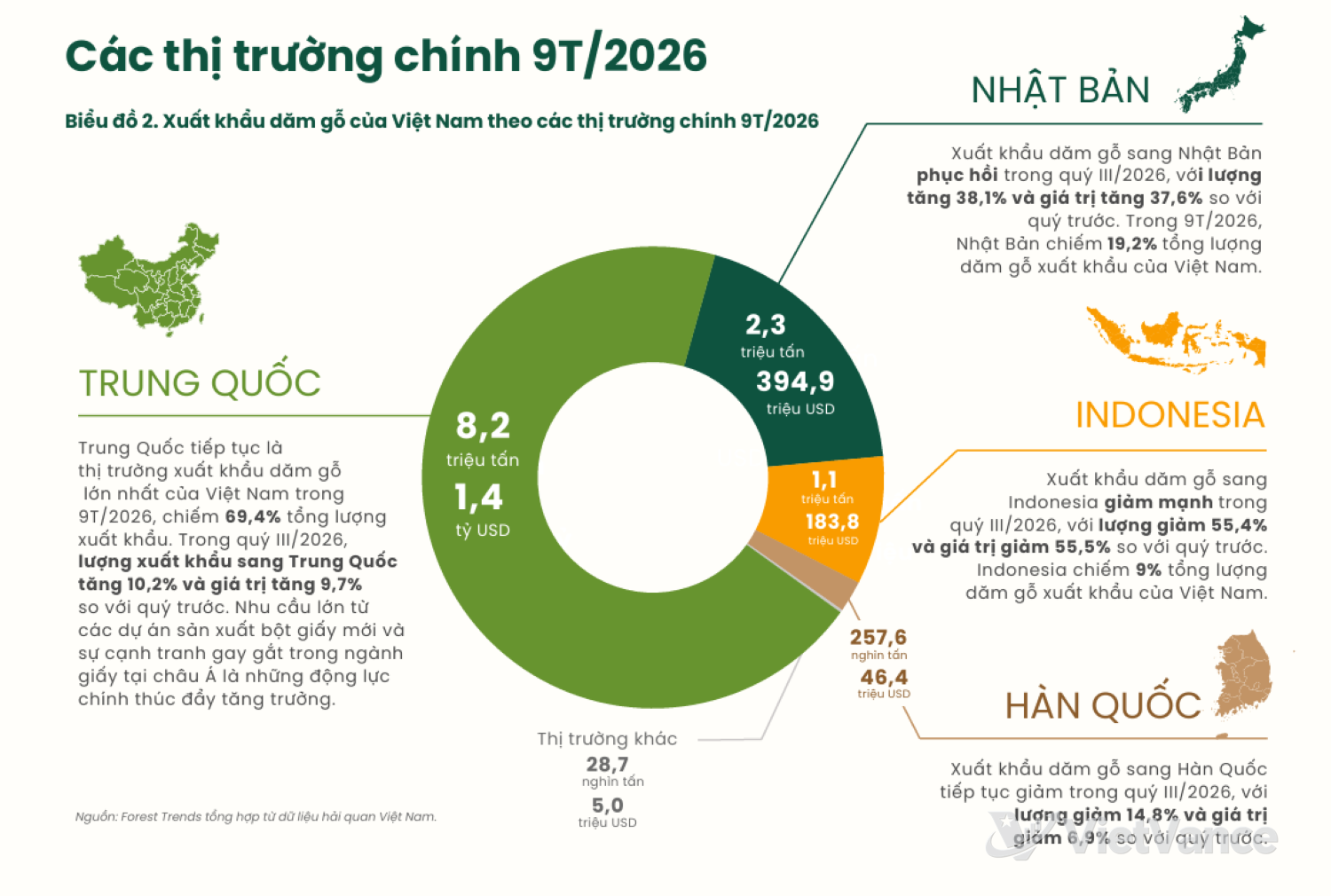
Vietnam’s main wood chip export markets. Chart source: Forest Trends.(VietVance)
Performance in other markets was mixed. In the third quarter, Vietnam’s wood chip export volume to Indonesia fell 55.4% from the previous quarter, while volume to South Korea fell 14.8%. In the first nine months, the average export price to China was approximately US$175.5 per tonne, up 23.7% year on year; the average price to Japan was US$174.4 per tonne, up 19.9%.
Wood chips are made mainly from plantation timber such as acacia and eucalyptus. The report noted that many plantations are harvested after three to four years to supply wood chip production, while products requiring further processing, such as furniture and engineered wood panels, need consistent quality, large diameter timber grown for at least seven years. These different raw material needs have intensified competition for supplies among processors, and some companies must also import timber at higher cost.
To increase the supply of raw materials for further processing, some wood product processors have proposed that the government ask the Ministry of Finance to study a phased increase in the wood chip export tax from the current 2% to approximately 5%–10%. They have also proposed considering wood chip export quotas in areas at risk of raw material shortages. These measures remain proposals from businesses.
Source: VietVance