Vietnam’s Wood Pellet Exports Slow as Volume and Value Fall in South Korea
A Forest Trends report shows that Vietnam’s wood pellet export volume and value both fell year on year in the first nine months of 2026. Japan remained the largest market, while weaker demand and lower export prices in South Korea, product quality concerns, price cutting and raw material traceability issues weighed on exports.

A report published by Forest Trends in November 2026 shows that Vietnam’s wood pellet export volume and value both fell year on year in the first nine months of 2026. Exports totaled 5.9 million tonnes, worth $874.5 million. Exports had grown in both 2024 and 2025, reaching 8.3 million tonnes and $1.212 billion in 2025.

Growth in Vietnam’s wood pellet exports is slowing. Chart source: Forest Trends.(VietVance)
Japan remained Vietnam’s largest export market for wood pellets. In the first nine months of 2026, Vietnam exported about 4.4 million tonnes to Japan, worth $670.8 million, accounting for 74.4% of its total export volume. In the third quarter, export volume to Japan fell 1.7% year on year, while export value rose 1.3%. Over the same nine-month period, exports to South Korea reached 786,700 tonnes, worth $89.8 million. In the third quarter, volume and value fell by more than 9.5% and 17%, respectively, year on year, mainly because of weaker demand there.
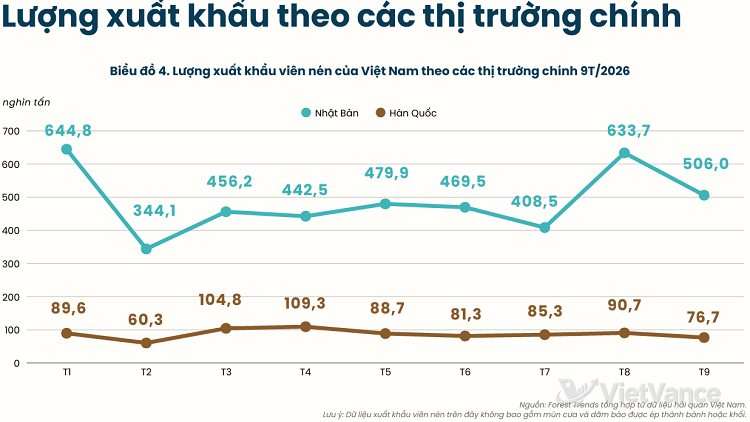
Vietnam’s monthly wood pellet export volumes to major markets in 2026. Chart source: Forest Trends.(VietVance)
Export prices also diverged across markets. In the first nine months of 2026, Vietnam’s average free on board price for wood pellets was about $148.3 per tonne, up 1.5% year on year. The average export price to Japan was $153 per tonne, up 3.1%, while the average price to South Korea was $114.2 per tonne, down 12.7%. During the same period, exports to the European Union totaled 249,600 tonnes, worth $38.1 million and accounting for 4.2% of total export volume.
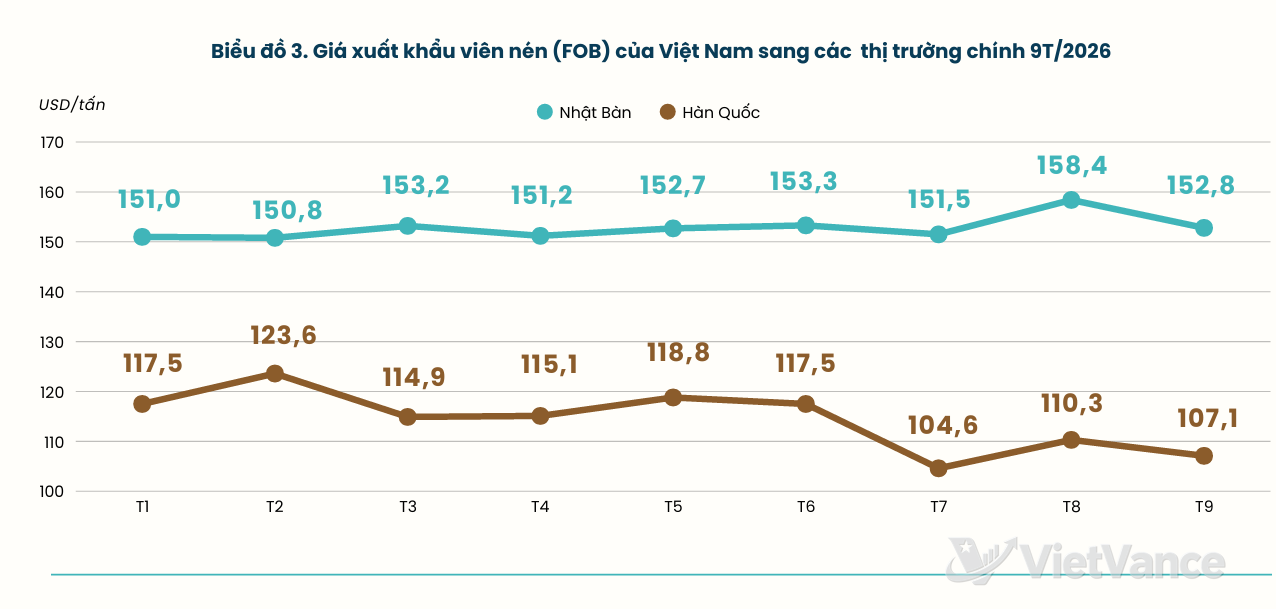
Monthly trends in Vietnam’s wood pellet export prices by major market in 2026. Chart source: Forest Trends.(VietVance)
Beyond changes in market demand, the industry faces pressure from product quality concerns and competition that drives prices down. Wood pellet production relies mainly on wood processing byproducts such as sawdust and wood shavings, and raw material supplies fluctuate with the seasons and production in the wood products industry. Wood and imported raw materials whose origins are difficult to trace also make it harder for companies to meet forest management and sustainable production certification requirements and the EU’s deforestation regulation, affecting access to markets with stricter requirements.
Source: VietVance