Rubber futures fall on November 19 as Japan’s market declines for third straight session
Japanese rubber futures fell for a third consecutive session on November 19, while Thai export quotes and Shanghai futures also declined. Lower Chinese tire output and Thailand’s approaching peak rubber supply season weighed on the market. Rubber purchase prices in Vietnam remained stable, while Brazil raised its import tariff on passenger car tires.

At the close on November 19, December rubber futures on Japan’s Osaka Exchange fell 2.48% to 417.4 yen per kilogram; Thailand’s export quote for RSS3 rubber at Laem Chabang fell 0.73% to 92.48 baht per kilogram; and the January 2027 contract on the Shanghai Futures Exchange fell 2.27% to 18,725 yuan per metric ton. Japanese rubber futures declined for a third consecutive trading day, pressured by oil price movements and weak tire demand.
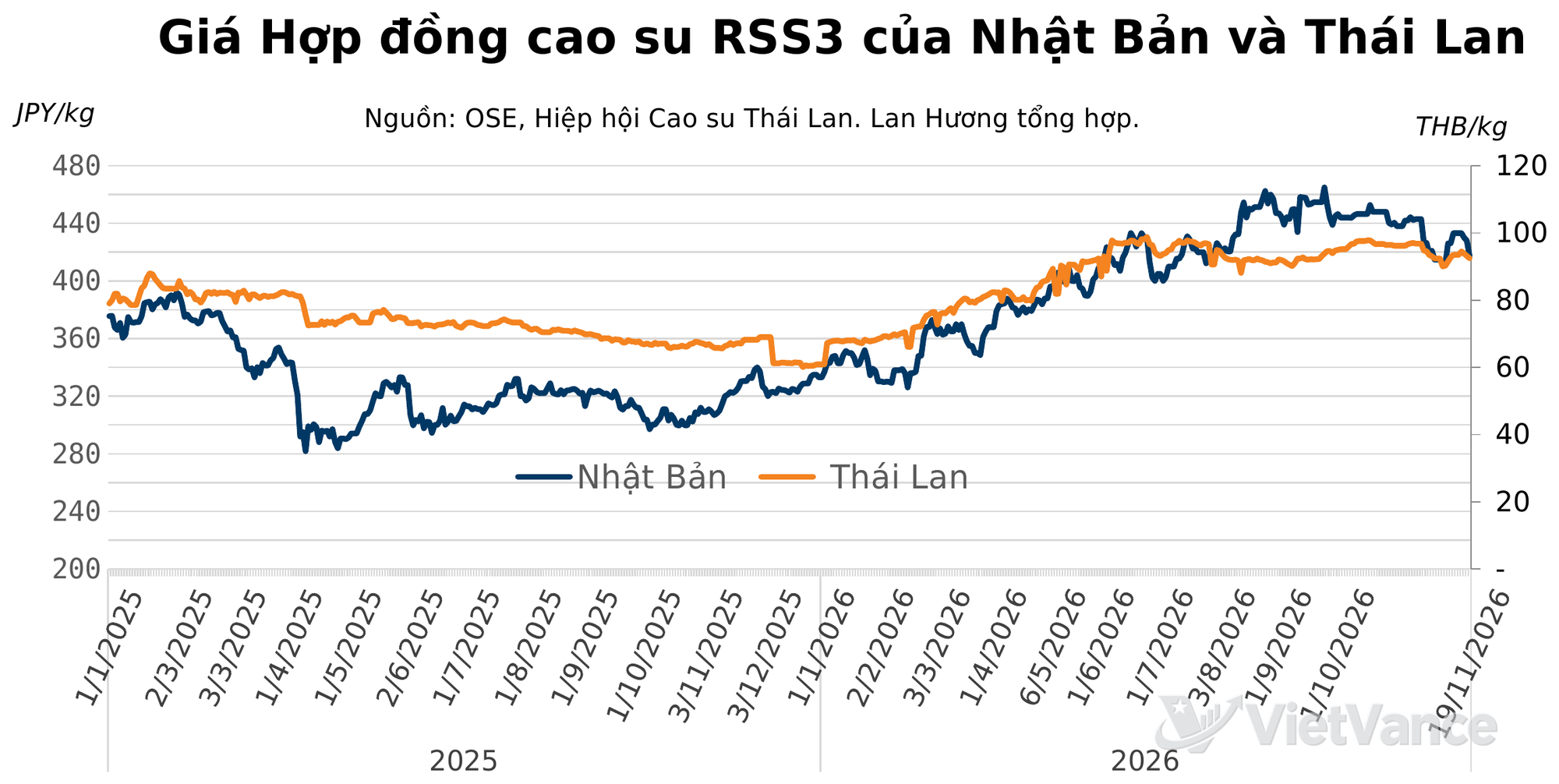
Rubber futures price trends in Thailand and Japan.(VietVance)
Hualian Futures analysts said tire manufacturers’ operating rates were below levels seen in recent years, while slower auto sales were also weighing on demand. Data from China’s National Bureau of Statistics showed that rubber tire production fell 4.6% year on year in October to 94.15 million units. Shenyin Wanguo Futures analysts said rubber-producing regions in Thailand were entering the peak supply season, with output expected to increase.
Rubber purchase prices in Vietnam remained stable. Bình Long’s factory purchase price was 540 Vietnamese dong per TSC point per kilogram, while its production teams paid 530 Vietnamese dong; the price of mixed latex was 18,000 Vietnamese dong per kilogram. MangYang paid about 458 to 463 Vietnamese dong per TSC point for liquid latex and about 404 to 459 Vietnamese dong per DRC point for coagulated mixed latex, depending on grade.
Chinese tire manufacturer Triangle Tire’s third-quarter net profit fell 89.5% year on year to 30 million yuan, while revenue declined 3.1% to 2.46 billion yuan. The company said the total cost of purchasing raw materials, including natural and synthetic rubber, rose 20.1% year on year. Unfavorable exchange rate movements also affected the company.
Brazil has raised its import tariff on passenger car tires to 30% for 12 months, with the new rate taking effect on November 9. Brazil’s National Tire Industry Association said China was a leading source of imports and Vietnam was among the sources of low-priced imported tires.
Source: VietVance