
Investing and Hedging with Stock Options: Rights, Costs and Risks
Option buyers pay for the right to buy or sell an underlying asset under agreed terms within a set period; sellers receive the premium and take on the corresponding obligation. Using hypothetical index options, the article explains four basic positions, hedging a stock portfolio, and how premiums, margin and expiration affect gains and losses.

An option buyer pays a premium for the right to buy or sell an underlying asset at the strike price within a specified period and may choose not to exercise it. The seller receives the premium and assumes the obligations set out in the contract. Underlying assets may include stocks, exchange-traded funds, stock indexes or futures contracts. Cash-settled index options pay the difference calculated under the contract, without delivery of the index’s constituent stocks.
The article uses hypothetical figures to illustrate gains and losses: the index stands at 1,000 points, with each point worth 100,000 Vietnamese dong. A call option with a strike price of 1,000 points costs 40 points, or 4 million Vietnamese dong. If the buyer holds it to expiration, the index must reach 1,040 points to break even before other costs; at 1,100 points, the net profit is 6 million Vietnamese dong. If the index is no higher than the strike price at expiration, the buyer loses the premium paid. The seller’s gains and losses are the reverse of the buyer’s, and a sharp rise in price could leave the seller of an unhedged call with losses far exceeding the premium received. These figures explain the mechanism only and do not represent a specific product currently traded in Vietnam.
Buying a call, selling a call, buying a put and selling a put are the four basic positions. Buying a put can be used to anticipate a decline or protect a stock portfolio; selling a call creates a corresponding obligation if the price rises. Even when both positions reflect the same expectation of a decline, their risks differ. A buyer may lose the entire premium, while the premium received by a seller limits potential gain, not potential loss.
In another hypothetical example, a stock portfolio worth 100 million Vietnamese dong moves in the same proportion as an index at 1,000 points. The investor pays 3 million Vietnamese dong for a put option with a strike price of 1,000 points. If the index falls to 900 points at expiration, the portfolio declines to 90 million Vietnamese dong and the option pays 10 million Vietnamese dong, leaving a combined value of 97 million Vietnamese dong after the premium. If the index rises to 1,100 points, the combined value is 107 million Vietnamese dong. This hedging outcome depends on how closely the portfolio tracks the index, the contract size and the expiration date; it cannot guarantee protection against risks specific to individual stocks.
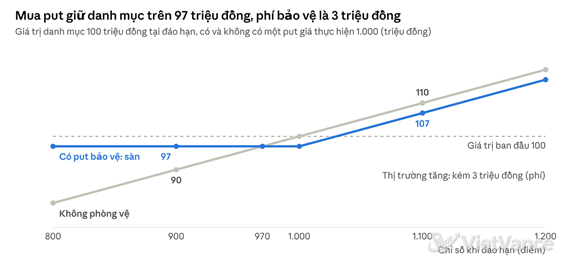
Illustration of the results of hedging a hypothetical stock portfolio by buying an index put option.(VietVance)
The option premium is the cost of buying a right, while margin helps ensure that the seller can meet their obligations. Initial margin is not the seller’s maximum potential loss. An option’s value is also affected by the time remaining and expected volatility: a buyer can still lose money even if the price moves in the predicted direction, if the move is too small to cover the premium or occurs only after expiration. Investors must also consider liquidity, the conditions for closing a position early, and any cash or securities needed for settlement after exercise.
Source: VietVance