Vietnamese business leader: Revenue growth may mask weakening competitive advantages
Trương Lý Hoàng Phi, chair of IBP and InnoEx, says low costs and abundant labor are becoming less effective sources of competitive advantage for Vietnamese businesses. Even while revenue grows, companies need to adapt their organizations and workflows early to turn technology investment into new strengths.

Trương Lý Hoàng Phi, chair of IBP and InnoEx, says Vietnamese businesses have grown by relying on low costs, abundant labor and established business models, but these strengths are becoming less effective at setting them apart from competitors. Revenue may remain stable in the short term, yet management needs to recognize the shift before the pressure appears in financial results. She cited figures showing that foreign-invested enterprises accounted for more than 77% of Vietnam’s exports in 2025, while exports by domestic businesses declined over the same period.

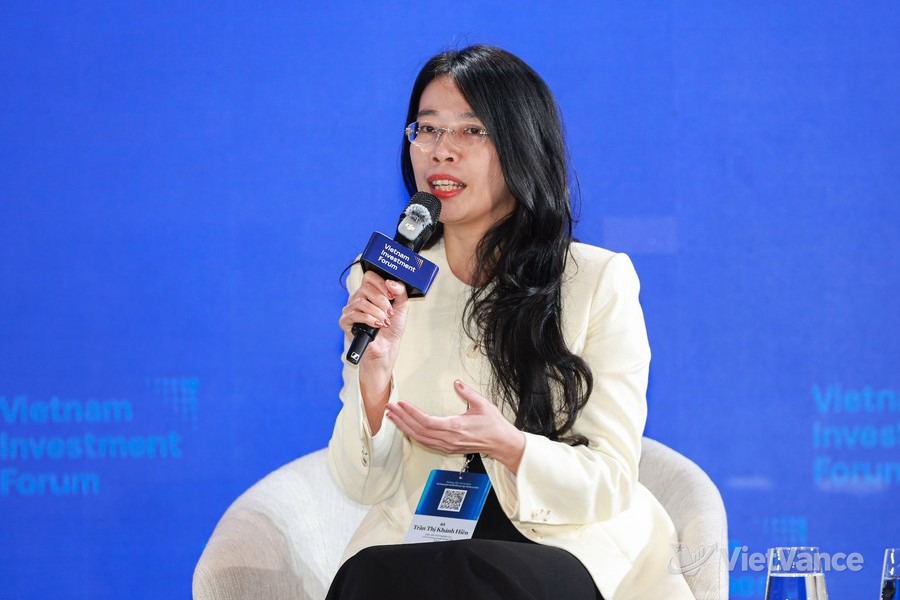
Trương Lý Hoàng Phi discusses changes in the competitive advantages of Vietnamese businesses.(VietVance)
She says artificial intelligence has reduced the resources companies need to develop products, while making advantages based on technology alone easier to copy. Citing Stanford University’s AI Index 2025, she says the cost of querying a model with performance comparable to GPT-3.5 fell by about 280-fold in 18 months. She argues that companies therefore need to build customer trust, industry knowledge and proprietary data, and integrate technology into everyday workflows.

Trương Lý Hoàng Phi discusses technology adoption and business competitiveness.(VietVance)
In her view, innovation projects often struggle to scale because of how companies allocate funding, share data between departments and measure performance. She recommends that innovation teams conduct trials focused on real business problems, working with business units from the outset to define implementation plans, budgets and measures of success. Companies can also collaborate with startups, research institutions and universities, but both sides need to build trust through measurable trials.
On policy, she notes that Vietnam’s Law on Science, Technology and Innovation took effect in October 2025 and established the principle of accepting risk in related activities, though implementation still lags. She recommends improving data standards and verification mechanisms, expanding procurement and ordering mechanisms for domestic innovative products, and extending the use of controlled trials to more fields in cities such as Ho Chi Minh City.
Source: VietVance