Battery Swapping Gains Ground for Electric Trucks in China, but Cost and Compatibility Remain Key Issues
China’s electric truck sales rose nearly 80% year on year in the first half of 2026, with about one-third using battery swapping. The model can lower upfront vehicle costs and reduce time spent replenishing energy, but incompatible batteries, limited station access and peak-hour charges constrain its use.

Battery swapping is gaining ground for electric trucks in China. BloombergNEF data show that Chinese electric truck sales rose nearly 80% year on year in the first half of 2026. According to The Guardian, about one-third of the electric trucks sold during that period used battery swapping. CATL launched a battery swapping system designed for trucks through its Qiji Energy brand in 2023.
Under the battery swapping model, customers typically buy a vehicle without a battery and lease one from a service provider. Mao Shiyue, a researcher at the International Council on Clean Transportation, said batteries account for about 40% of an electric truck’s price, so leasing one helps reduce the upfront cost. Swapping also cuts the time needed to replenish energy: Wang Bing, a driver who travels between Haikou and Dongfang in Hainan province, said each swap takes about five minutes, compared with about 1.5 hours for plug-in charging.
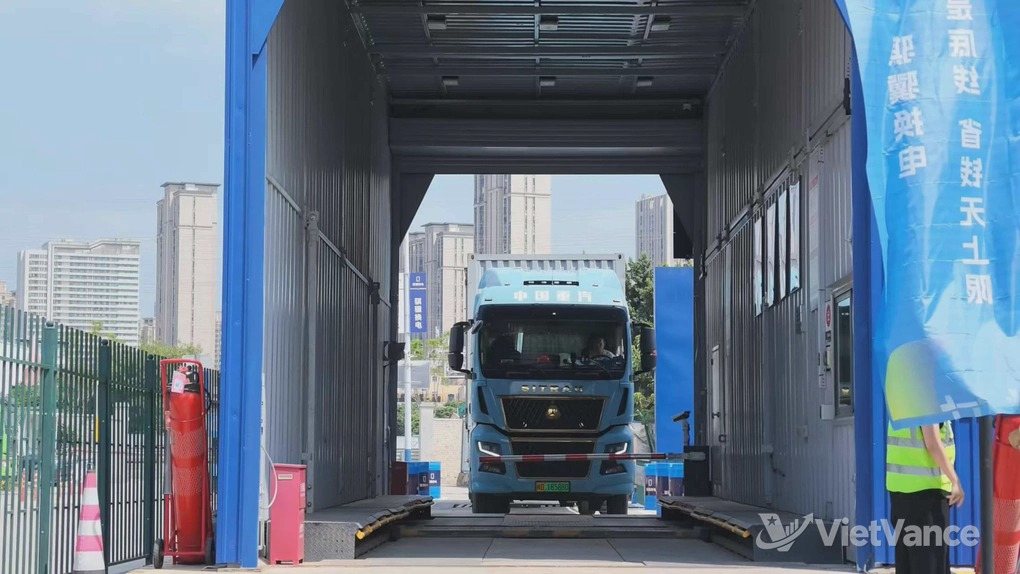
A truck enters a Qiji Energy battery swapping station operated by CATL.(VietVance)
Wang Bing transports about five tonnes of goods between the two cities each day on a round trip of about 500 kilometres. He said that since switching to an electric truck, his energy cost has been about 1.1 yuan per kilometre, while a diesel truck would cost nearly twice as much, saving him more than 20,000 yuan a month. CATL plans to have 900 battery swapping stations operating across China in 2026 and 2,000 by the end of 2027. The company is also testing automated battery swapping that allows drivers to remain in their vehicles.
Battery swapping is limited by compatibility among vehicles, batteries and stations. Xue Lulu, a senior specialist at the World Resources Institute, noted that drivers cannot replenish energy at just any swapping station. Some also wait outside stations for one to two hours to avoid peak-hour charges. Mao Shiyue said battery swapping is currently better suited to freight transport on fixed routes, such as those serving ports and factories or running within or between cities.
Source: VietVance