Vietnam pepper prices fall for fourth day, below VND 130,000 in some areas
On November 21, pepper purchase prices in most surveyed areas of Vietnam fell for a fourth consecutive day, dropping VND 1,000–2,500 per kg from the previous day to VND 128,000–132,000 per kg. Black pepper prices in Indonesia and Brazil also declined. Vietnam’s pepper and spice industry association urged exporters to check certification requirements and trade risks in the UAE market.

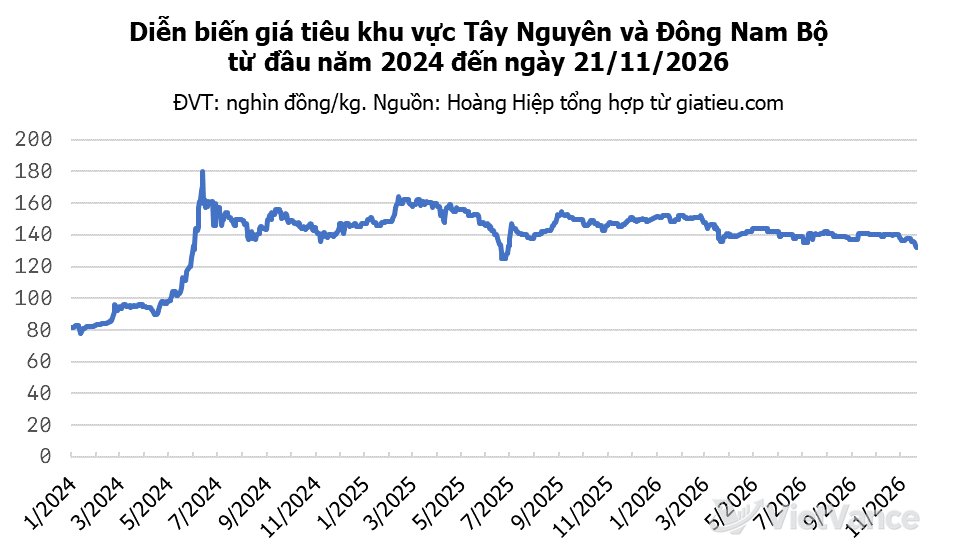
On November 21, pepper purchase prices in most surveyed areas of Vietnam fell for a fourth consecutive day, down VND 1,000–2,500 per kg from the previous day to VND 128,000–132,000 per kg.

Pepper purchase prices in surveyed areas of Vietnam on November 21.(VietVance)
Purchase prices in Bà Rịa – Vũng Tàu (Ho Chi Minh City) and Bình Phước (Đồng Nai) both fell VND 2,500 per kg, to VND 128,500 and VND 128,000 per kg, respectively. Gia Lai fell VND 2,000 to VND 128,000 per kg; Đắk Nông fell VND 1,000 to VND 130,000 per kg. Đắk Lắk held steady at VND 132,000 per kg, the highest price among the areas listed.
According to the International Pepper Community, Indonesian black pepper fell 0.32% to USD 6,748 per tonne in the latest trading session, while Brazilian ASTA 570 black pepper fell 2.78% to USD 5,400 per tonne. Malaysian black pepper held steady at USD 9,100 per tonne. Export quotations for two grades of Vietnamese black pepper remained unchanged from the previous day at USD 5,700 and USD 5,900 per tonne, respectively.
International black pepper quotations on November 21.(VietVance)
For white pepper, Indonesia’s quotation fell 0.66% from the previous day to USD 9,184 per tonne. Export quotations from Vietnam and Malaysia remained at USD 8,300 and USD 12,000 per tonne, respectively.
At a seminar on the UAE market held on November 16, Hoàng Thị Liên, chairwoman of the Vietnam Pepper and Spice Association (VPSA), said Vietnam’s pepper and spice industry exported more than 22,000 tonnes to the UAE in 2025, accounting for nearly 10% of the industry’s total export volume. She said the CEPA agreement offers market opportunities, but businesses still need to verify rules on origin, food safety and Halal certification, carefully check importers’ credentials, and assess transport, insurance and financing costs.
Source: VietVance