Vietnam’s Pepper Prices Hold Steady as Processing Offers a Path to Higher Export Value
On November 12, pepper purchase prices in Vietnam’s main producing areas held at VND 135,500–138,000 per kilogram, while international prices were also stable. Industry representatives say better processing, storage, transport and packaging could increase the value of Vietnam’s pepper exports.

On November 12, pepper purchase prices in Vietnam’s main producing areas remained at VND 135,500–138,000 per kilogram, unchanged from the previous day. The purchase price in Đắk Lắk was VND 138,000 per kilogram, while Gia Lai’s was VND 135,500.

Pepper purchase prices in Vietnam’s main producing areas remained stable on November 12.(VietVance)
Data from the International Pepper Community show that pepper prices in major producing countries also remained stable. Vietnamese black pepper graded at 500 g/l and 550 g/l was quoted at USD 5,950 and USD 5,995 per tonne, respectively; black pepper was quoted at USD 6,799 per tonne in Indonesia, USD 5,700 in Brazil and USD 9,100 in Malaysia. Vietnamese white pepper was quoted at USD 8,450 per tonne.
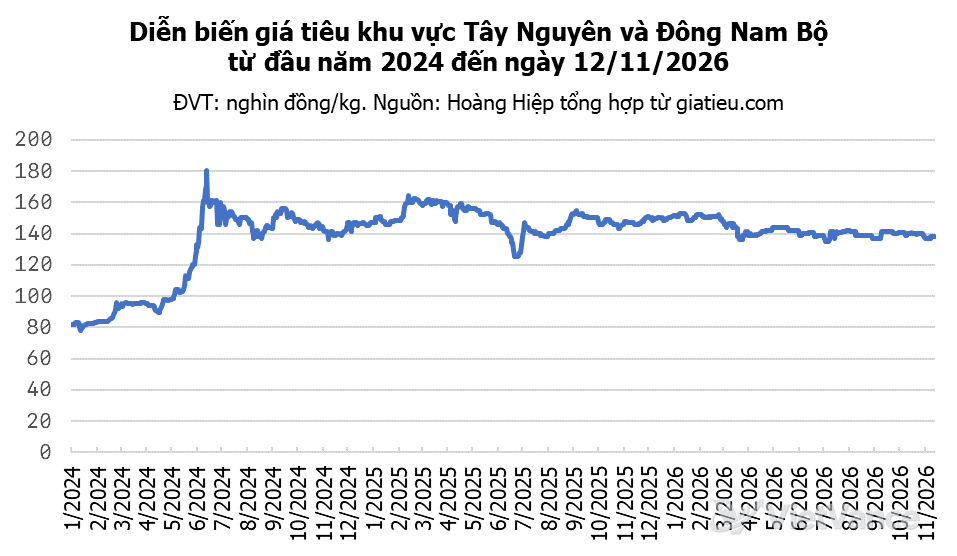
Pepper prices in major producing countries remained stable on November 12.(VietVance)
Hoàng Thị Liên, chair of the Vietnam Pepper and Spice Association (VPSA), said Vietnam’s pepper export value chain still faces fragmented production and difficulties with quality control and traceability. Although some companies have invested in processing technology for products such as white pepper and ground pepper, raw pepper still accounts for a large share of exports, while major markets continue to raise their food safety and sustainability requirements.
Phúc Sinh Joint Stock Company has invested in cold drying, fine grinding and vacuum packaging technology. The company example cited in the original article shows that shifting from raw pepper exports to ground pepper and packaged products raised selling prices from about USD 3,000–3,200 per tonne to USD 5,000–6,000 per tonne. Advanced processing also requires capital, technology, staff and stable sales channels.
VPSA Secretary-General Lê Việt Anh said transport, warehousing, storage and container detention costs could erode the price advantage of Vietnamese pepper. Pepper also requires strict controls on moisture, storage conditions and the risk of cross-contamination. If storage and transport fall short of requirements, testing and treatment costs may rise, and customers may even reject shipments.
Source: VietVance