Vietnam’s Provinces Target Double-Digit Growth as Labor and Investment Efficiency Become Key Challenges
In 2026, 30 of Vietnam’s 34 provinces and cities were assigned targets of at least 10% growth in gross regional domestic product, but only 12 reached that pace in the first nine months. Limited labor force growth and declining domestic migration constrain efforts to grow by expanding industrial parks and attracting workers.

After Vietnam’s government updated its growth plan on June 27, 2026, 30 of the country’s 34 provinces and cities were assigned targets of at least 10% growth in gross regional domestic product (GRDP). In the first nine months, only 12 recorded double-digit growth, while 24 grew more slowly than their full-year targets. National gross domestic product (GDP) was estimated to have grown 9.01% over the same period; Hanoi and Ho Chi Minh City grew 8.85% and 9.06%, respectively.
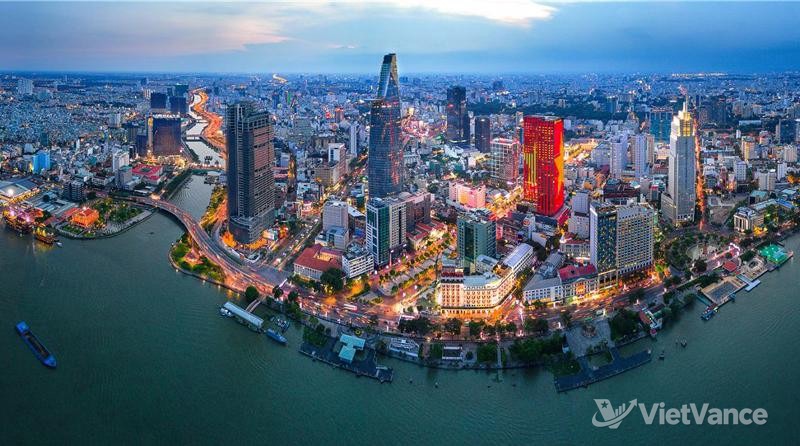
Vietnam is entering a new stage of development with expectations of higher growth. File photo.(VietVance)
Government calculations released on October 5 showed that fourth-quarter GDP growth would need to reach about 12.5% for Vietnam to achieve 10% growth for the full year. Nine provinces and cities would need to grow by more than 15% in the fourth quarter. Lạng Sơn faced the highest required rate, at 18.41%; Hanoi and Ho Chi Minh City would need growth of 16.55% and 13.23%, respectively.
Labor supply is a shared constraint on local expansion. In the first nine months of 2026, Vietnam’s labor force stood at 53.8 million, up about 697,000, or approximately 1.3%, from a year earlier. Data from the Ho Chi Minh City Employment Service Center showed 82,762 job vacancies and 52,641 jobseekers in the first quarter of 2026. The 2024 midterm population and housing survey found that about 4 million people had migrated in the five years before the survey, down from 6.7 million in 2009.

Public policy expert Huỳnh Hồ Đại Nghĩa.(VietVance)
Public policy expert Huỳnh Hồ Đại Nghĩa said migration between provinces does not increase the national labor force; workers attracted to one area may be lost to another. GRDP mainly records output where people work, making it difficult to fully capture the costs borne by the places that raised and trained those workers, or the benefits of public investment that extend across regional boundaries. The 2024 survey found that, among people who migrated to the Southeast from other regions, about 353,100 came from the Mekong Delta, accounting for more than half. These figures use regional boundaries from before the administrative reorganization.
Growth rates alone cannot measure each locality’s contribution to the national economy. In 2025, Ho Chi Minh City’s GRDP grew 7.53%, ranking 21st among 34 provinces and cities by growth rate, yet it contributed 23.11% of national economic growth. Vietnam’s average incremental capital-output ratio was 6.43 in 2021–2025, while the target for 2026–2030 is to reduce it to 4.5–4.8. How localities allocate capital, land and labor will affect the country’s ability to meet its investment efficiency target.
Source: VietVance