Vietnam’s Capital Region Ring Road 5 to Receive Up to VND 61.394 Trillion in Central Funding
Vietnam has issued a resolution to implement Capital Region Ring Road 5. Up to VND 61.394 trillion in central funding is planned for 2026–2030 to build an approximately 116 km expressway section through four localities. Construction is scheduled to begin in 2027, with the entire route targeted for completion before 2035.

On November 24, 2026, the Vietnamese government issued Resolution No. 406/NQ-CP to implement the Capital Region Ring Road 5 project. From 2026 to 2030, the central budget will allocate no more than VND 61.394 trillion to build an approximately 116 km expressway mainline through Hai Phong, Bac Ninh, Ninh Binh and Hung Yen. The funding may not be used for land acquisition compensation, resettlement or parallel road construction.
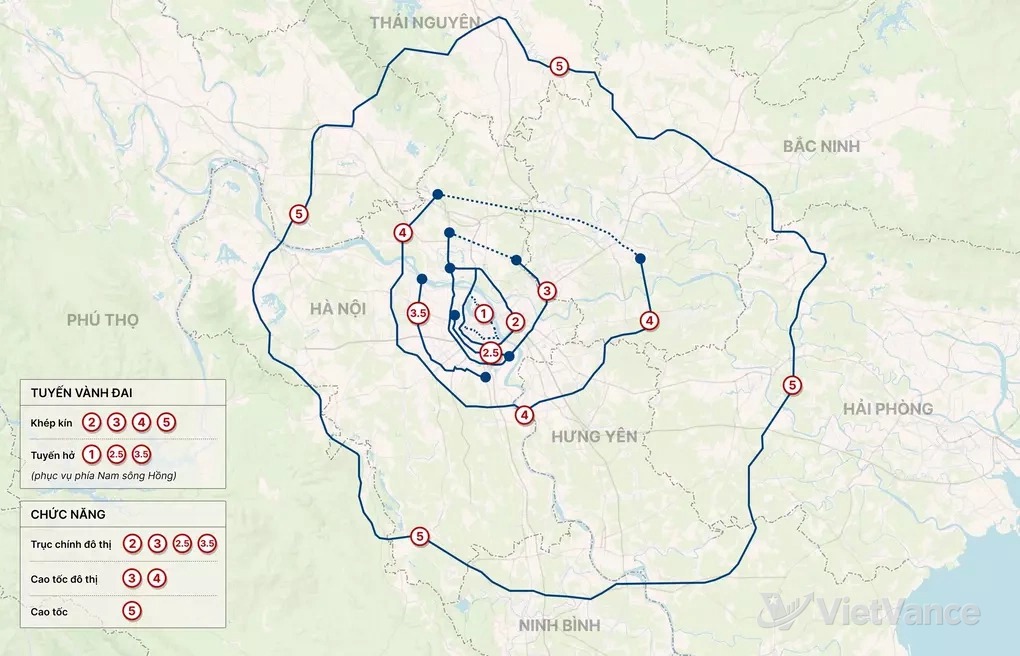
Map showing planned ring roads in Hanoi.(VietVance)
The Ministry of Construction will work with local authorities to propose funding sources and disbursement schedules for the mainline subprojects and submit them to the Ministry of Finance for consolidation. Hanoi, Hai Phong, Bac Ninh, Ninh Binh, Hung Yen, Thai Nguyen and Phu Tho must allocate local budget funds for land acquisition, compensation, resettlement and parallel road construction. The relevant authorities will also continue assessing the feasibility of using public-private partnerships for some subprojects to attract funding from outside the state budget.
The four localities must aim to hand over at least 70% of the required land before September 2027 for construction packages scheduled to start that year, and the remaining land in the second quarter of 2028. Hai Phong, Bac Ninh, Ninh Binh and Hung Yen must also prioritize parallel roads to support local traffic after the mainline enters service. The Ministry of Industry and Trade must establish an interregional construction materials coordination mechanism before September 2027.
The subprojects for the approximately 116 km mainline must receive approval in the second quarter of 2027. Construction is scheduled to begin that September, be substantially completed in 2030 and enter operation in 2031. The remaining subprojects must be completed in coordination with the overall project before 2035, when the government aims to complete the entire route. Local authorities along the route must also study plans for industrial parks, urban areas and other developments, as well as how revenue from the related projects would be shared.
Source: VietVance